IPB University’s OVOC Program Breaks Through with Purple Sweet Potato Exports to Malaysia and Singapore
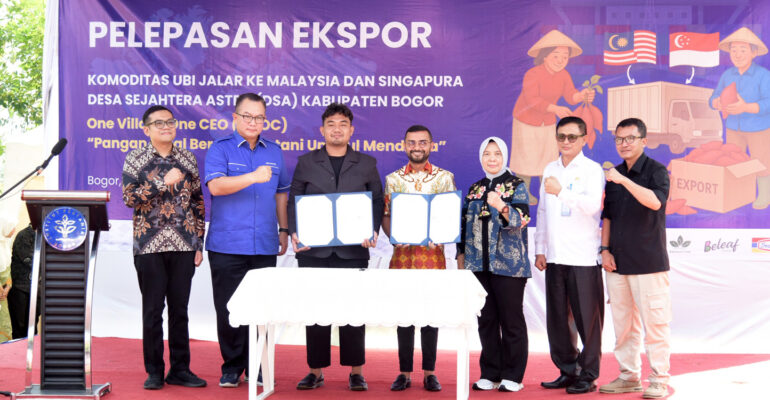
IPB University continues to demonstrate its commitment to community empowerment based on local potential, particularly through the development of village agricultural products via the One Village One CEO (OVOC) program.
Most recently, IPB University launched exports of purple sweet potatoes to Malaysia and Singapore, produced by farmers from villages surrounding the campus. The symbolic export launch event took place at the Agribusiness and Technology Park (ATP) of IPB University in Bogor on (7/22).
Since 2024, IPB University, through the Directorate of Agromaritime Community Development (DPMA), has established a sweet potato business ecosystem that now spans over 13 villages in Bogor Regency. This program has successfully penetrated the export market with a total of over 65 tons of sweet potatoes in the first semester of 2025.
At that time, IPB University Rector Prof Arif Satria stated that by 2025, the OVOC program had been implemented in 1.430 villages across Indonesia. The program involves final-year students and alumni as village CEOs, playing a role in opening access to technology, markets, and financing for village communities.
“A CEO is not just a title, but a learning process that begins when students first enter IPB University. According to talent mapping results, 31 percent of IPB University students aspire to become entrepreneurs,” he said.
“This is commendable because entrepreneurs are not merely seeking profit but creating value for society. They generate jobs, leverage IPB University innovations, and deliver social and economic impacts,” Prof Arif added.
Additionally, he noted that IPB University is actively promoting the export of agricultural products to the United States, Pakistan, India, and Malaysia, as well as chili peppers to Japan, thanks to innovations in pesticide residue removal using nano-technology.
In collaboration with PT Astra International, IPB University is also processing goat manure waste in Cipanas, Garut, into planting media that is currently exported to 11 countries. Garut coffee products have also penetrated the markets of eight countries.
“IPB University’s vision today is to become an Innopreneur University, generating impactful innovations. We aim not only to be the ‘kitchen of the world’ but to ‘feed the world’ through agricultural innovations,” emphasized Prof Arif.
On the same occasion, Director General of National Export Development at the Ministry of Trade of the Republic of Indonesia, Fajarini Puntodewi, expressed appreciation to IPB University for its contributions in supporting national export development.
Ilham Indanu Sitepu, an alumnus of the Department of Islamic Economics at IPB University, class of 57, and CEO of OVOC, stated that this program directly impacts the economic improvement of farmers.
“The success of purple sweet potato exports is the result of collaboration between IPB University, the government, and private sector partners like Desa Sejahtera Astra, which supports five villages as production partners. Relevant stakeholders strongly support this ecosystem,” he said.
In the initial phase, the exported products are still raw materials. However, in the future, Danu aims to develop downstream products by collaborating with sweet potato chip factories, so that the villages can have processed sweet potato-based products that are competitive in the global market. (AS) (IAAS/ASY)