
IPB University Professor’s Name Immortalized as the Name of a Unique Leafy Ornamental Plant with Striking Leaf Bones Like Paintings
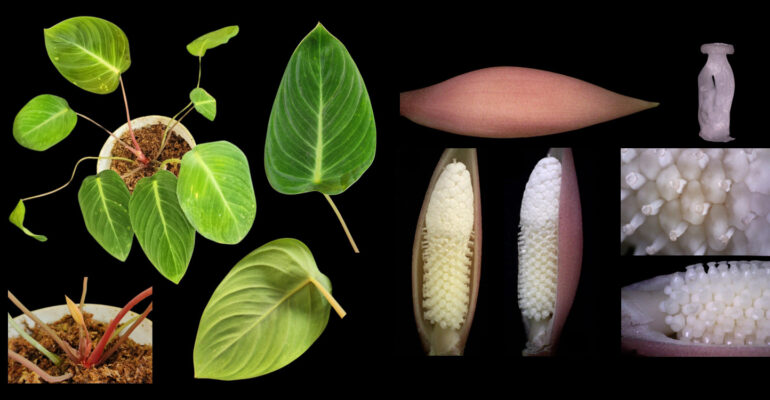
IPB University Professor, Prof Tatik Chikmawati was officially immortalized as the scientific name of a new plant species from the Araceae (aroid) family. The new species was successfully discovered by a team of researchers from the Research Center for Biosystematics and Evolution (PRBE), National Research and Innovation Agency (BRIN) in Riau Province.
The plant was named Homalomena chikmawatiae in honor of Prof Tatik Chikmawati for her contribution to the development of plant biosystematics in Indonesia.
Prof Tatik Chikmawati is a Professor of IPB University in the Department of Biology, Faculty of Mathematics and Natural Sciences (FMIPA). The doctoral degree winner in Plant Science from the University of Missouri, United States, is active in teaching various courses and guiding S1, S2, and S3 students.
The results of this research have been published in the international journal Webbia: Journal of Plant Taxonomy and Geography, Volume 80(1), pages 99-104, April 2025, with the title “Nomenclatural Changes and New Species in Malesian Homalomena (Araceae)” (Irsyam et al, 2025).
“The paper was written by two alumni of IPB University under my guidance when taking S2 at IPB, namely the first author Arifin SD Irsyam and the last Muhammad R Hariri,” said Prof Tatik when interviewed.
The uniqueness of Homalomena chikmawatiae
Prof Tatik revealed that this plant has various advantages both in terms of aesthetics and ecological functions.
“Homalomena chikmawatiae is very low maintenance, suitable for beginners, and very good as an indoor ornamental plant. The leaves are unique, with contrasting colors and striking leaf bones like paintings,” she explained.
According to Prof Tatik, this plant is easy to cultivate because it has high adaptability. It prefers low light or shade and does not require excessive watering.
“Simply planted in infertile soil, it can grow. This saves on maintenance costs and labor,” she says.
Its natural habitat is found in rocky, sloping, and slightly shaded areas, indicating that this plant is not suitable for open areas exposed to intense direct sunlight.
Apart from being an ornamental plant, Homalomena chikmawatiae is also believed to have great potential in the health and industrial fields. The plant is said to be able to absorb air toxins such as formaldehyde and benzene, making it ideal for enclosed spaces such as offices or homes. Interestingly, its fragrant leaves have the potential to be developed into a perfume base.
“In addition to absorbing pollutants, this plant also has the potential as an air remediation agent. In the long run, it can also be developed for health products or medication, although further research is still needed,” said Prof Tatik.
It is known that plants from the Homalomena family have long been used by the community as traditional medicine, especially to treat swelling and infection due to their antibacterial secondary metabolites. However, for this new species, the potential must still be studied scientifically.
Prof Tatik emphasized the importance of species preservation through sustainable use. According to her, when a plant has use and economic value, people will be encouraged to cultivate it, which in turn supports its conservation.
“If this plant continues to be utilized, whether for ornamental plants, medicine, or perfume, people will take care of it. That is a form of need-based conservation,” she explains.
The discovery of Homalomena chikmawatiae not only enriches the diversity of Indonesia’s flora, but also paves the way for the sustainable and economically valuable use of local plants.
“We researched how people utilize the plants around them, especially in remote areas. From there we filtered, then tested in the laboratory and published. All that remains is for the industry to seize the opportunity,” she concluded. (IAAS/KQA)

