
IPB University Launches IPB 11S Bepe, a Salt-Tolerant Rice Variety Suitable for Coastal Areas
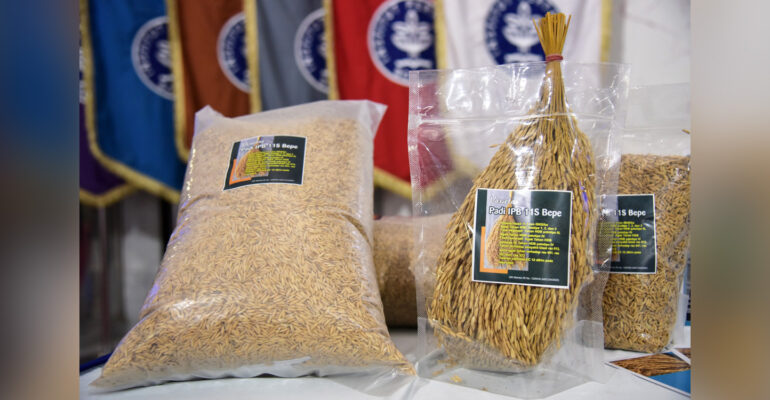
IPB University, in collaboration with the Ministry of Agriculture (Kementan) and the National Research and Innovation Agency (BRIN), has once again launched a salt-tolerant (salt content) rice variety. This new superior variety (VUB) is named IPB 11S Bepe and was officially launched at the “Launching of Outstanding Research Results” event on Tuesday (7/22).
The breeders include Prof Bambang Sapta Purwoko, Dr Willy Bayuardi Suwarno, Akhmad Hidayatullah, M.Si, Anggita Duhita Anindyajati, M.Si (IPB University); Dr Iswari Saraswati Dewi (BRIN); and the late Dr Heni Safitri (Kementan).
“The advantages of VUB IPB 11S Bepe include an average productivity of 7,7 tons per hectare with a potential yield of 11,5 tons per hectare and a short maturity period (111 days after planting/DAP). For comparison, the current national average productivity of irrigated rice is 5,29 tons per hectare,” he said.
Regarding resistance to pests and diseases, Prof Bambang noted that IPB 11S Bepe is moderately resistant to brown planthopper biotypes 1, 2, and 3. This innovation is also resistant to bacterial leaf blight pathotype III and moderately resistant to pathotype IV during the vegetative phase, moderately resistant to pathotype III and resistant to pathotype IV during the generative phase; as well as resistant to blast disease (race 013) and moderately resistant to three blast races, namely races 041, 053, and 373.
“In terms of grain and rice quality, IPB 11S Bepe has a broken rice yield of 70 percent, a milled rice yield of 63 percent, and a head rice yield of 80 percent. The texture of the rice is soft with an amylose content of 25 percent,” he explained.
Rice for Saline Lands
Prof Bambang explained the background behind developing the IPB 11S Bepe variety, which is tolerant to salinity (EC 12 dS/m). He revealed that, to date, national rice production is still focused on irrigated rice fields, especially in Java and Bali. However, challenges in rice fields are increasing with the expansion of land conversion and climate change.
“As an archipelagic nation, Indonesia has a lengthy coastline. Most of this coastal land is used for rice production. Therefore, efforts to develop rice cultivation can be directed toward marginal lands with potential for food production,” he explained.
Farmers near the coast are beginning to face salinity problems due to seawater intrusion into rice fields or other agricultural land as a result of rising sea levels and climate change. Salinity also occurs in areas with low rainfall and during the dry season.
According to BRIN, there are around one million hectares of agricultural land in Indonesia affected by salinity. This has the potential to reduce national crop yields and productivity.
“Given the large potential for land exposure to salinity, the development of high-salinity-tolerant rice varieties such as IPB 11S is expected to increase rice production in areas near the coast or rice fields with waterways directly connected to the sea,” he said.
For example, in Java, saline-affected areas (saline land) are found in coastal rice fields in the northern coastal region (Pantura). This area is a major rice-producing region. Outside Java, saline land is scattered across several provinces, particularly in coastal areas and former salt pans.
Some commonly affected areas include South Kalimantan, North Sumatra, Aceh, South Sumatra, and Riau. Saline land can also be found in other regions such as Central Sulawesi and East Nusa Tenggara, though with varying prevalence.
To date, IPB 11S Bepe has been planted by farmers in several districts in West Java (Bogor, Karawang, Sukabumi, Cirebon), East Java (Sidoarjo, Malang, Blitar), and West Sumatra (Payakumbuh and Dharmasraya).
Prof Bambang recommends that IPB11S Bepe be cultivated following the Integrated Crop Management (ICM) guidelines for paddy rice up to an elevation of 600 meters above sea level (dpl).
“With the launch of the IPB 11S Bepe variety, we hope to provide a new paddy variety to support the expansion of rice cultivation in saline-prone areas as part of efforts to achieve sustainable food security,” he said.
The IPB11S Bepe rice variety was released on April 14, 2023, by the Indonesian Minister of Agriculture. Efforts to produce seeds and disseminate IPB 11S Bepe will be continued in collaboration with PT Botani Seed. (dr) (IAAS/LAN)

