
IPB University Expert Highlights Challenges in Forest and Land Fire Control at the Ministry of Forestry’s Technical Working Meeting
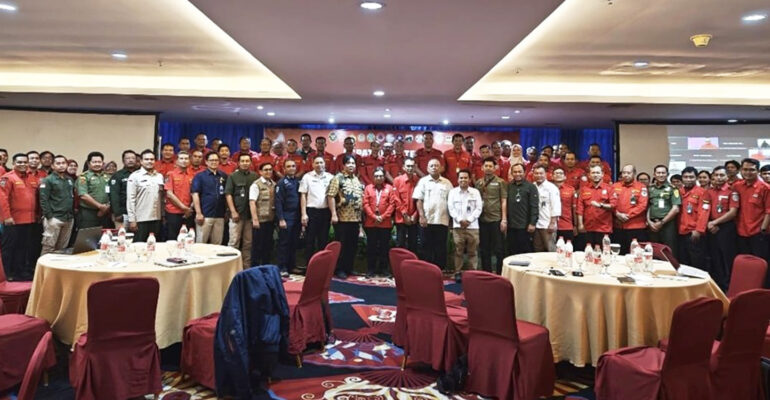
Prof Bambang Hero Saharjo, Executive Director of the Regional Fire Management Resource Center-Southeast Asia (RFMRC-SEA) at IPB University, highlighted various serious challenges in the control of forest and land fires (karhutla) in Indonesia.
He conveyed this message during the Technical Working Meeting on Forest Fire Control for 2025, organized by the Directorate of Forest Fire Control, Directorate General of Law Enforcement, Ministry of Forestry, Republic of Indonesia.
In his presentation titled “Evidence-Based Forest and Land Fire Control,” presented to approximately 300 participants, Prof Bambang outlined the alarming global fire situation. Citing a statement from the FAO Forestry Division Director, he revealed that the global extent of forest and land fires reached 300 million hectares, a truly startling figure.
“For Indonesia, greenhouse gas (GHG) emissions from peatland fires were reported by the Minister of Environment and Forestry to the UNFCCC in 2022 as one of the major contributors to emissions from Land Use, Land-Use Change, and Forestry (LULUCF), accounting for 50,13 percent. Therefore, forest and land fire control must be taken seriously,” Prof Bambang said.
The situation is expected to become even more challenging in the future. According to a 2022 report by the United Nations Environment Programme (UNEP), extreme fires are predicted to increase by 14 percent by 2030, 30 percent by 2050, and 50 percent by 2100.
To address these challenges, Prof Bambang recommended several measures. First, the regulations used must be clear and unambiguous. Second, there needs to be an increase in the capacity of the Brigade Manggala Agni (BMA) members and their facilities and infrastructure.
“Initially, the BMA was formed to control forest and land fires within national park areas. However, as the demand for fire suppression outside these areas grew, their responsibilities increased. Therefore, capacity-building, equipment, and infrastructure upgrades are necessary,” he explained.
According to him, the high expectations placed on the BMA is a form of high appreciation from society. However, appreciation alone is not enough to extinguish the fires. “Hence, there needs to be clear status recognition for BMA members and adequate equipment,” Prof Bambang concluded. (IAAS/EXC)

