IPB University Becomes a Place for Foreign Students to Learn Indonesian Language and Culture
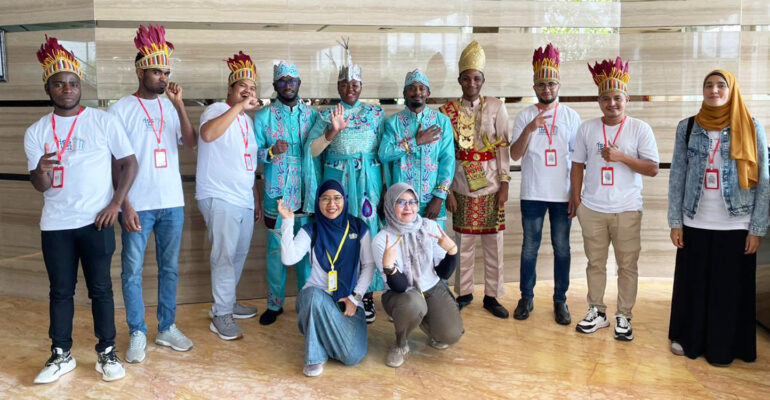
Dozens of foreign students from various countries across five continents are participating in the Indonesian Language Program for Foreign Speakers (BIPA) at IPB University. This program not only teaches language skills but also introduces Indonesian culture through practical activities such as cooking, dancing, and singing regional songs.
The BIPA program is facilitated by three institutions: the Directorate of General Competency Education (PKU) for undergraduate (S1) programs; the Graduate School for master’s (S2) and doctoral (S3) students; and the Directorate of International Education for recipients of the Indonesian AID Scholarship (TIAS).
Dr Defina, SS, MSi, an Indonesian language lecturer at IPB University, explained that BIPA is part of IPB University’s official academic program. The program is offered twice a week with a weight of two semester credit units (SKS).
“This program is open to students from various categories, such as international class participants, exchange students, and short-term research students,” said Dr Defina when met at the IPB Dramaga Campus, Bogor (7/21).
Students participating in the program come from various countries, such as Malaysia, Japan, Korea, Thailand, Australia, the United States, the Netherlands, Germany, Ireland, Sudan, Yemen, and others. “There are also those who come just to support their research activities,” she added.
In addition, BIPA is also part of the scholarship requirements for international students, including those from the Ministry of Foreign Affairs and Developing Countries Partnership (KNB) program. Scholarship recipients are required to take Indonesian language courses for one semester to one year, depending on the requirements of their respective programs.
“Students from the KNB program who come from universities throughout Indonesia are required to study Indonesian for one year. They are generally master’s and doctoral students from various fields of study,” she said.
In this program, Dr Defina explained, IPB University provides agricultural material as a distinctive feature.
Despite coming from various backgrounds, such as computer science, nutrition, economics, and business, students are equipped with a general understanding of agriculture, forestry, agribusiness, and agricultural statistics.
“Therefore, we have compiled a special textbook that covers agriculture-related topics to support learning during the first semester,” she added.
In addition to focusing on grammar, reading, writing, and vocabulary, the learning process also includes cultural introduction. Students are encouraged to learn about Indonesian culture through hands-on activities such as cooking traditional dishes (rendang, black sticky rice, bakwan, and others), singing, and dancing local songs. They also introduce dishes from their home countries to be enjoyed together.
Not only that, but activities outside the classroom, such as visits to Taman Mini Indonesia Indah (TMII), Istiqlal Mosque, Jakarta Cathedral, Ragunan Zoo, and Kota Tua, are part of the contextual learning method.
“By getting to know Indonesia’s diversity and history firsthand, they better understand the use of language in real life,” added Dr Defina.
As a complement, international students are also given the opportunity to interact directly with Indonesian students to practice their language skills practically. They are even asked to conduct interviews with local communities as part of their learning assignments.
The BIPA program at IPB University combines language instruction with an understanding of Indonesian culture and social context, providing a comprehensive learning experience for international students from around the world. (dh) (IAAS/LAN)