Dean of FEM IPB University Reveals Three Important Lessons from the Role of Waqf in Strengthening Turkey’s Military Industry
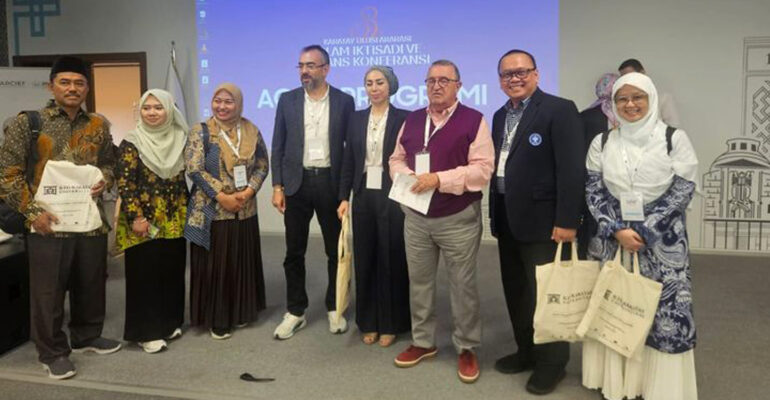
Prof Irfan Syauqi Beik, Dean of the Faculty of Economics and Management (FEM), revealed interesting information about the role of waqf in strengthening Turkey’s military industry. He concluded this from his attendance at the opening of the 3rd Karatay International Conference on Islamic Economics and Finance in Konya, Turkey on Wednesday (7/16), together with Dr Laily Dwi Arsyianti (Chairperson of IPB University’s Center for Sharia Business and Economics Studies).
Prof Irfan revealed an interesting statement delivered by a world-renowned waqf expert, Prof Murat Cizakca. He stated that waqf has played an important role in Turkey’s history, not only during the Ottoman Empire, but also in Turkey’s modern history.
“One of them is in strengthening Turkey’s military industry, which has grown into a force that is increasingly taken into account by the world. Even the Indonesian government is rumored to have purchased 48 KAAN fighter aircraft produced by Turkish Aerospace Industries (TAI/TUSAS),” he said.
History Begins with the 1964 Cyprus Crisis
In his keynote speech, Prof Murat Cizakca stated that the rise of Turkey’s military industry began with events that occurred in 1964. At that time, there was a conflict between the Greek Cypriot majority and the Turkish Cypriots in the territory of the country of Cyprus.
Political and ethnic tensions created the Cyprus Crisis of 1963-1964. At that time, a letter from US President Lyndon B Johnson was sent to Turkish Prime Minister Ismet Inonu, who strongly warned Turkey not to use weapons provided by the US and NATO in its conflict with Cyprus.
The US President’s letter angered the Turkish people and government, but also made them realize that they need to start building their own defense industry. “Don’t be dependent on the US and other countries,” said Prof Irfan quoting Prof Murat Cizakca.
What the Turkish government did was beyond prediction. They instead built waqf instruments to build their defense industry. Waqf for the military. More than 83 thousand citizens donated their waqf money in order to build a more independent Turkish military industry, through the establishment of various foundations in their Army, Navy and Air Force.
“The collected waqf funds are then used to fund engineers and defense experts and buy shares of companies engaged in the defense industry. With this fund, the research and development (R&D) that underlies the development of Turkey’s military industry was developed,” explained Prof Irfan.
Establishment of the Turkish Armed Forces Foundation
On September 26, 1987, the Turkish Armed Forces Foundation (TAFF or in Turkish known as TSKGV) was established. One of the functions of this foundation is to collect public funds, particularly social donations and endowments, which are used for the purpose of developing and strengthening their military.
The foundation then buys shares in various companies, such as TAI/TUSAS as a fighter aircraft manufacturer, Roketsan (Turkey’s leading rocket and missile manufacturer), Havelsan (a software manufacturer in the defense and information technology industry), and FNSS (a manufacturer of armored vehicles and combat systems). Even the KAAN purchased by Indonesia is an ambitious project designed to replace the existing fleet of US-made F-16s in the Turkish Air Force fighter squadrons.
“So, the effect of waqf is very powerful. Turkey is a clear example of how waqf plays an important role in strengthening their military,” said Prof Irfan.
“When they were dealing with political and diplomatic problems, even being embargoed by the US in 1974-1978, then when they did not have enough state budget to build their defense industry, cash waqf appeared to be the best solution,” he concluded.
Three Lessons for Indonesia
According to him, based on Prof Murat Cizakca’s presentation, there are three lessons that can be taken in the Indonesian context.
First, waqf is a very powerful instrument that can mobilize community contributions on a massive and wide scale. In the case of Turkey, the combination of love for religion and the state has awakened the spirit of the Turkish people to sacrifice their much-loved wealth for the benefit of their religion and country.
“Religiously, waqf gives them eternal rewards. In terms of the state, waqf can contribute to one very important aspect in ensuring the security and sovereignty of the state, which is military power. The right campaign made the government at that time have a very large waqf fund, without burdening their state budget,” said Prof Irfan.
Secondly, he continued, to get to that level, he saw that there are conditions that must be met. Namely, waqf management must be accountable so that it is trusted by the public, strong military institutions that are trusted by the people, and a common perception of the country’s interests that must be prioritized so as to create massive and strong solidarity.
Third, waqf will function and play its role well when it is supported by three pillars: effective literacy and education, modern, trustworthy and professional nazir institutions, and the support of appropriate regulations and policies.
“Therefore, to optimize the potential of waqf, it is time for the government to give stronger attention, especially cash waqf. Also, how an integrated and productive waqf ecosystem can be built and developed sustainably,” explained Prof Irfan closing his explanation. (*/Rz)(IAAS/ASY)