
IPB University ARL Lecturer Becomes Indonesian Delegate at UN Forum, Bringing the Idea of Child-Friendly Green Space for Post-Disaster Recovery
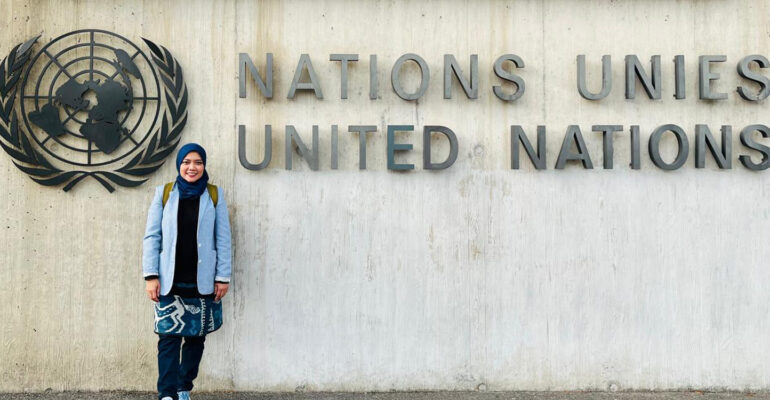
Lecturer of Landscape Architecture (ARL), Faculty of Agriculture, IPB University, Dewi Rezalini Anwar, SP, MADes was selected as a delegate representing Indonesian academics at the Global Platform for Disaster Risk Reduction (GPDRR) 2025.
The GPDRR is a global disaster risk reduction forum organized every three years by the United Nations (UN). The 8th GPDRR was held in Geneva, Switzerland on June 2-6, 2025.
The UN forum on disaster risk reduction was attended by more than 3.400 participants from 166 countries around the world. Forum participants are delegates from various countries in the world, both from high state institutions such as presidents and ministers, non-governmental organizations (NGOs), academics, to the private sector.
“The process of becoming a delegate of this forum is through the selection of proposals and curriculum vitae (CV). I participated in providing a point of view based on my background in various presentation sessions, discussions, and stakeholder forums that focus on disaster risk reduction issues,” said Reza, her nickname, (6/18).
In the UN forum, Reza brought perspectives from her research on child-friendly green open spaces (RTH) for post-disaster recovery from a landscape architecture perspective. The researcher and doctoral student at the University of Leeds, UK, is interested in how outdoor space design can help children recover psychologically, physically and socially after a disaster.
“During my participation in GPDRR2025, the response to my research on child-friendly green spaces for post-disaster recovery was quite positive, especially from representatives of countries that have repeated experience of natural disasters such as Japan, the Philippines, and Nepal,” she said.
“One of the NGO delegates active in post-disaster areas even expressed interest in exploring further collaboration and adapting this approach in their projects,” said the lecturer and practicing landscape architect.
She added that some delegates noted that space and landscape-based approaches to support children’s psychosocial recovery are often overlooked. So far, post-disaster planning has generally focused on short-term recovery and infrastructure.
“The discussion highlighted the importance of inclusivity or children’s involvement in the design of public spaces,” said the IPB University lecturer who is also a delegate to the International Federation of Landscape Architects (IFLA) and humanity volunteer with SalamAid.
In addition, the need for more specific guidelines or policies to integrate more specialized aspects such as healing environments, mitigation spaces, or multifunctional spaces in the context of disaster for recovery strategies was also discussed.
According to her, this kind of response shows that there is a gap that has not been much touched in Disaster Risk Reduction (DRR) policies, especially regarding the emotional well-being of children after disasters through landscape design interventions.
Reza feels grateful to be one of the delegates at the UN forum on disaster risk reduction. “I see this opportunity as a space to learn, share, and expand networks with various parties who have the same concern for building a more resilient, inclusive, and pro-vulnerable environment such as children,” she concluded. (MHT) (IAAS/PRO)

