
Celebrating Harganas, IPB University Introduces the Concept of Family Friendly Development
Family as the foundation of national character building is now facing serious challenges. Starting from structural poverty, divorce, weak parenting, to shifting values due to external cultural flows that threaten the quality of human resources (HR) and the future of Indonesia.
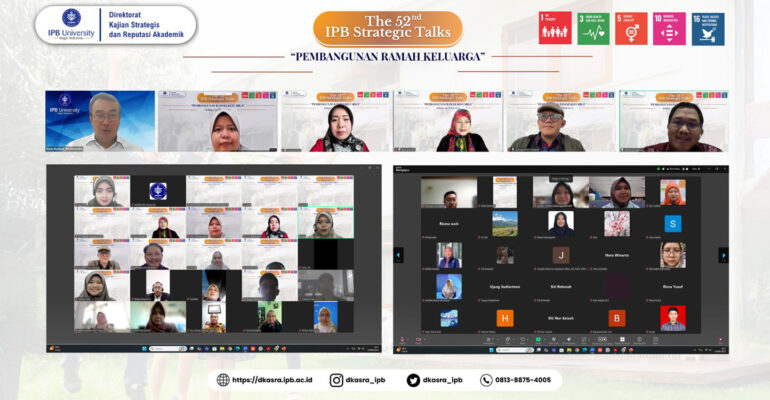
Welcoming the National Family Day (Harganas) on June 29th, IPB University also tried to provide a strategic dialogue space related to this issue. In The 52nd Strategic Talks event, IPB University introduced the concept of Family House Development (PRK).
Prof Euis Sunarti, a Professor of Family Resilience and Empowerment of IPB University explained, based on 30 years of academic journey, the concept of CRP emphasizes the importance of placing the family as the central point in every national development policy, with a holistic and sustainable approach.
“PRK not only prioritizes family resilience, but also strengthens the synergy between the region, work, and the social environment that supports the welfare and quality of life of Indonesian families,” she explained at the event held by the Directorate of Strategic Studies and Academic Reputation (DKSRA) IPB University.
In order to realize a competitive and civilized Golden Indonesia 2045, Prof Euis encourages policy transformation that makes families the subject and object of development. “We need to make families the basis of national development policies and programs,” she concluded.
On the other hand, so that poor families can move up the social class, Dr Ivanovich Agusta, a lecturer at the Faculty of Human Ecology, IPB University, explained a number of strategies. The expert in sociology, village development, and community development emphasized the need to reform the approach to poverty reduction.
“Poverty reduction needs to be changed from short-term assistance to a sustainable empowerment process,” she said. For this reason, he continued, it is necessary to update family-based data, measure poverty more holistically, and localize the targets of the Sustainable Development Goals (SDGs) through policies that favor poor families.
“The strategy is two-stage, namely meeting basic needs and equipping families with skills and market access. This is the key to vertical social mobility for poor families to get out of poverty with dignity,” she explained.
In conclusion, Dr Yulina Eva Riany, chairpersom of the Center for Gender and Child Studies at IPB University, emphasized the importance of the idea of PRK as a collective agenda. “We all need to intensify this idea so that the government has a strong political will in making the family the unit of development and the basis of national policy.” (IAAS/AVM)

