IPB University and NCMS Hold Study of Meeting Point, Building Inclusive Dialogue Across Science and Religion
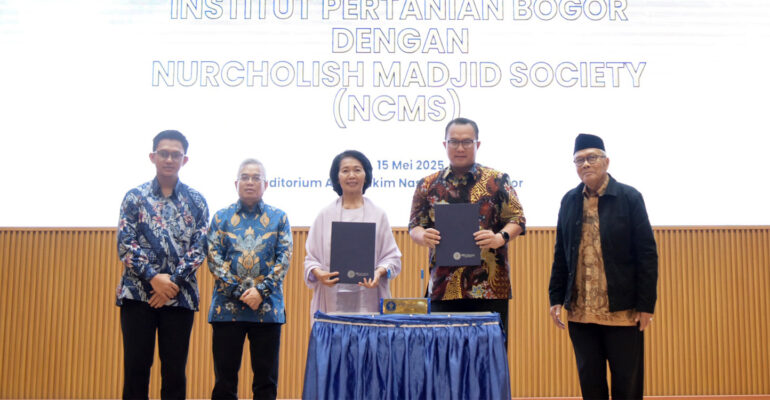
In an effort to strengthen the culture of interdisciplinary dialogue, IPB University in collaboration with Nurcholish Madjid Society (NCMS) organized Kajian Titik Temu at IPB Dramaga Campus, Bogor.
This activity became a reflective forum for the academic community and the public to answer the challenges of the times through a tolerant and civilized approach.
In his speech, the Director of Cooperation, Communication, and Marketing of IPB University, Dr Alfian Helmi, conveyed an invitation for collaboration in the study of meeting points in the campus environment.
“This forum is a space for dialog between students and the academic community to bring together ideas from various scientific perspectives,” he said.
Dr Alfian said that IPB University rejects political segregation based on differences. Instead, the meeting point becomes a place to establish understanding between paradigms.
IPB University, continued Dr Alfian, is committed to becoming an inclusive campus through various admission channels. One of them is the invitation selection without a test initiated by Prof Andi Hakim Nasution, which is now known as the National Selection Based on Achievement (SNBP). This program opens opportunities for the best students from all over Indonesia.
Meanwhile, Chairman of the Board of Trustees of the Nurcholish Madjid Society, Omi Komaria Madjid, stated that this meeting point study is one of the programs to socialize the value of rahmatan lil alamin.
“Through this study, we want to instill inclusive, tolerant and pluralistic insights to the community, especially the younger generation,” she said.
She said that these values are important as part of a shared commitment to realizing the nation’s big dream, which is an equal Indonesia. According to her, this ideal is the legacy of the founding fathers of the Republic.
“Equality is the main principle that we must uphold together, both in religious, political and economic life,” she said.
Rector of IPB University, Prof Arif Satria, said that the thoughts of Nurcholish Madjid or Cak Nur are still very relevant to the challenges of today.
“We must continue to revive his ideas about religion that is open and has a real impact on social life,” he said.
Prof Arif explained that the role of religion needs to be studied more deeply, especially in two important aspects, namely behavior change and economic change. According to him, religion not only shapes beliefs, but also encourages work ethic and social responsibility.
These studies, according to him, need to be revived because the challenges faced today are very different compared to the past. One of them is the rapid advancement of technology.
“The presence of artificial intelligence (AI) needs to be responded to by all religions. There are ethical, legal and human dimensions that must be explored,” he said.
In this study, Muslim scholars were also present, Dr Yudi Latif, was also present to share his views on the importance of building an inclusive society. He said that the ideal of equality is not only legal, but must also become a social awareness that grows in every individual.
“Equality must be understood as a relationship between cultural subjects who respect each other and are equal in social space,” he said. (dr) (IAAS/LAN)