Abundant Maggot Harvest! Himasiter PPK Ormawa Rama Program in Sinarsari Village Turns Organic Waste into Benefits
Sinarsari Village, Dramaga Subdistrict, Bogor, West Java, implements organic waste management through an environmentally friendly program (Rama) initiated by the Student Organization Capacity Strengthening Program (PPK Ormawa) team of the Animal Nutrition and Food Student Association (Himasiter) of IPB University.
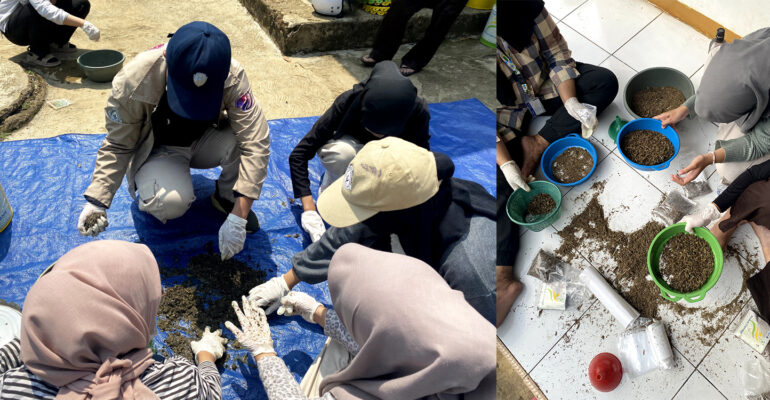
This program is the first initiative to introduce the maggot cultivation method in the village as a solution to the problem of organic waste. This initiative succeeded in transforming piles of organic waste that had been considered a problem into an economically valuable and environmentally friendly resource through maggot cultivation in the Camago House (worms and maggots).
Maggot or Black Soldier Fly (BSF) larvae is an innovative solution implemented by this program. Organic waste, which previously accumulated in several places, is collected and processed with the help of maggots.
The chief of the Camago House committee, Munir, said “Waste collection is done every three days, organic waste is given to maggots and inorganic waste is transported by garbage trucks.”
He admitted that these larvae are very efficient in decomposing organic matter, accelerating the decomposition process, while producing high-quality organic fertilizer. “In addition, adult maggots can also be used as a source of animal feed that is high in protein, thereby increasing the productivity of local livestock,” he said.
The chief of the Rumah Camago program, Ilham prasetyo, explained that the success of this program cannot be separated from the support of the Sinarsari Village community who are enthusiastic in adopting this method. “We are very grateful for the community’s involvement. They not only receive the benefits of this program, but are also active in the process of managing organic waste into value-added products,” said ilham.
The Himasiter PPKO team’s harvest this month reached around 30 kg. This is the first step to start and provide benefits for the future. In addition, the organic fertilizer produced is in great demand by local farmers because it is rich in nutrients.
However, Ilham said, the results obtained at this time are still below the maximum potential that should be achieved. This is due to the uneven understanding and involvement of the community in utilizing organic waste as the basic material for maggot development.
In an effort to overcome this challenge, IPB University students regularly conduct education and counseling to the community about the importance of organic waste management. The team also seeks to build awareness that organic waste management not only reduces the burden on the environment, but is also able to increase the economic income of residents through the harvest of maggot and organic fertilizer.
Irma, one of the residents of Sinarsari Village who has been involved in this program, shared her experience. “At first I wasn’t too interested because I didn’t understand what maggot was and how it could be useful. However, after participating in the training and seeing the results, I became interested in collecting organic waste and helping to sensitize local residents to dispose of food waste at the camago house,” said Irma.
Ilham hopes that, along with increased public awareness, the maggot harvest in the future will be more optimal. “We are optimistic that this program will continue to grow and become a sustainable solution for organic waste management in Sinarsari Village. The active participation of the community is very important to achieve maximum results,” he concluded. (*/Rz) (IAAS/HLF)