IPB University Vocational School Empowers KWT Ciharashas Through Tabulampot and Toga Training
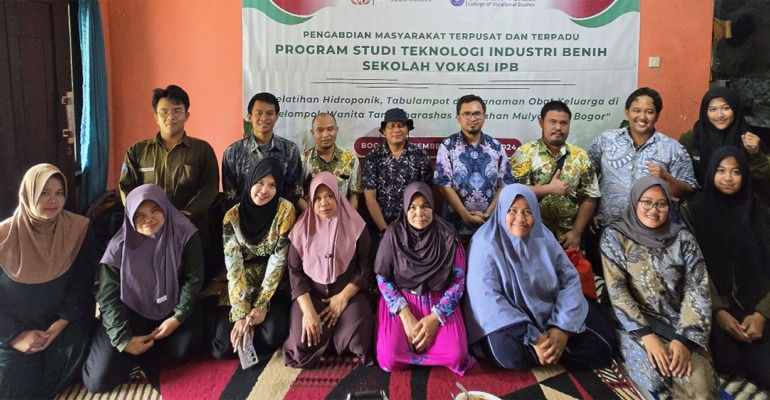
The Seed Industry Technology (TIB) Study Program of IPB University Vocational School conducted a training programme with the Ciharashas Women Farmers Group (KWT) in the framework of a centralised and integrated Community Service Program (PPM) for two days.
The first day of the event was opened by the Chief of Prodi TIB IPB University, Dr Aldi Kamal Wijaya. He hoped that this training activity would have a positive impact on KWT Ciharashas and TIB Study Programme. “Hopefully in the future the programme will be able to help KWT Ciharashas to be productive again and be able to produce agricultural products in the form of food crops and horticultural crops so as to improve the community’s economy in agriculture,” said Dr Aldi.
Meanwhile, Agus Faisal, Field Agricultural Extension Officer of Mulyaharja Village, said, “We thank you for the training held in Mulyaharja Village with KWT Ciharashas. We welcome the arrival of Prodi TIB IPB University at KWT Ciharashas.”
Before entering the material presentation session, the participants were invited to do a pretest with the topic “Family Medicinal Plants (Toga) and Fruit Plants in Pots (Tabulampot)”. This step was taken to determine the initial ability of KWT members on the topic of activities to be carried out in the garden.
The presentation of tabulampot material was delivered by Dr Undang as the Secretary of TIB IPB University and continued with a discussion session. The Chairperson of KWT, Umyati, conveyed the problem of the condition of potted fruit plants belonging to KWT Ciharashas which had not borne fruit for 4 years.
“Through the discussion, the root cause of the unproductive plants was obtained because citrus fruit plants, guava, and several other commodities require sufficient sunlight, while in the garden, the plants are covered with other plant canopies and block sunlight from reaching the plants,” said Dr Undang.
The highlight of this community service event was the field practice which included two main activities: transplanting fruit plants into planter bags for the tabulampot topic, and transplanting family medicinal plants into garden soil for the toga topic. In the tabulampot topic, the commodities used were button guava, crystal guava, and sawo. Preparations for transplanting included the provision of materials such as planter bags and compost.
Meanwhile, the plants that were moved to the garden were moringa and bay plants. The transplanting process begins by making a planting hole in the bare soil at the edge of the garden. (*/Lp) (IAAS/RSL)