IPB University Lecturer Involved in Developing Sustainable National Octopus Fishery Management Plan
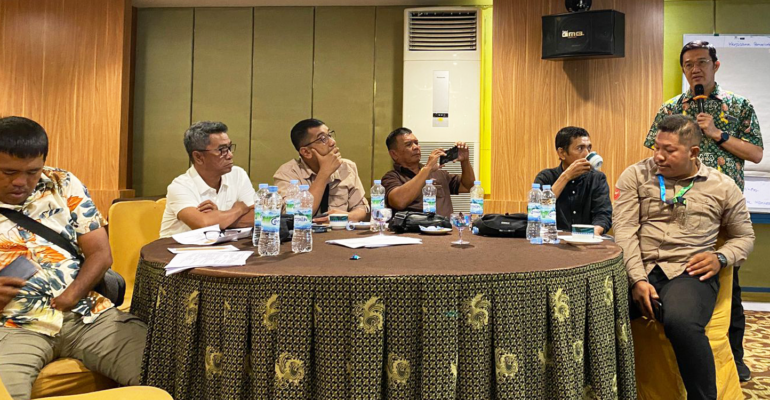
Dr Am Azbas Taurusman, a lecturer from the Department of Fisheries Resource Utilization (PSP), Faculty of Fisheries and Marine Sciences (FPIK), IPB University, conducted a stakeholder consultation activity to develop a draft Fishery Management Plan (RPP) for Octopus in Makassar, South Sulawesi.
Present at the event was Dr Fery Sutiawan, Chief of the Archipelagic and Territorial Sea Management Team, Directorate General of Capture Fisheries, Ministry of Marine Affairs and Fisheries (KKP), who is also an alumnus of PSP IPB University. Other stakeholders in attendance included representatives of octopus fishermen and businesses, the Chief of the Marine Affairs and Fisheries Agency (DKP) of South Sulawesi Province, the Chief of DKP of Central Sulawesi Province, and non-governmental organizations (NGOs).
During the event, the chiefs of agencies presented the condition of octopus fisheries and related policies in their regions.
In the stakeholder consultation, Dr Azbas stated that octopus is one of Indonesia’s fishery products with continuously increasing export volume and value (2018-2022 data). The largest export destinations for octopus are Italy, the United States, China, Greece, South Korea, and Japan (Fish Quarantine Agency, Quality Control, and Fishery Product Safety/BKIPM KKP, 2020).
“However, on the other hand, octopus fisheries experience dynamics in fishing seasons and export markets that determine octopus catch production and its implications for the socio-economic aspects of octopus fishermen. Therefore, it is important to consider this in the Octopus Fishery Management Plan (RPP) in the Fishery Management Area of the Republic of Indonesia (WPPNRI),” he explained.
According to him, the Octopus RPP is prepared to support octopus resource management policies as mandated in Article 41 paragraph (1) of Government Regulation Number 27 of 2021 concerning the Implementation of Marine Affairs and Fisheries. This policy aims to serve as a guideline for the KKP, local governments, related agencies, and other stakeholders in implementing octopus resource management in WPPNRI to achieve optimal and sustainable benefits.
Furthermore, Dr Azbas continued, the current issue in octopus fisheries indicates stock degradation, especially for the blue octopus species (Octopus cyanea) in WPPNRI 573, 713, 714, and 716.
In preparing the Octopus RPP draft with stakeholders, Dr Am Azbas explained that the scope of the Octopus RPP, as per KKP Ministerial Regulation Number 22 of 2021, covers three aspects: a) Status of octopus fisheries; b) Strategic plan for octopus management; and c) Management period and evaluation.
“To consider the total amount of octopus catch in WPPNRI, the management of octopus fisheries is focused on WPPNRI 571, 572, 573, 711, 713, 714, 715, and 716,” he explained.
Additionally, various priority issues form the basis for determining action plans in the Octopus RPP. These plans also need to be agreed upon and implemented by stakeholders, especially octopus fishermen.
“Management activities with synergy between universities and local governments become important to improve the limitations of scientific information. This is also important to fill policy gaps, including reviewing regulations on suitable catch sizes for octopus fisheries in WPPNRI that need to be regulated to ensure the sustainability of octopus catch resources,” he concluded. (*/Rz) (IAAS/Aly)