
Here it is IPB University’s Underwater Robot Innovation
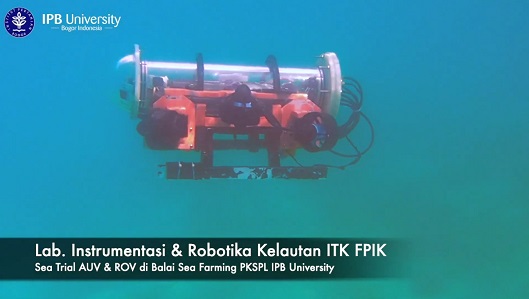
IPB University has a numerous of innovations developed for the advancement of agromaritime. One of them is the development of underwater robot innovations called autonomous underwater vehicles (AUV) and remote operating vehicles (ROV) by the Marine Instrumentation and Robotics Laboratory, Department of Marine Science and Technology (ITK), Faculty of Fisheries and Marine Sciences (FPIK).
Some time ago, the ROV and AUV named Nusantara-ROV and the 5th generation Nusantara-AUV were tested for their performance at the Sea Farming Center, Center for Coastal and Marine Resources Studies (PKSPL) IPB University. The two robots are used to monitor the cover of barnacles, a type of marine animal in cage nets.
In addition, IPB University is also developing underwater robots to monitor Indonesian sea conditions which are increasingly needed. Especially because the condition of Indonesian waters is difficult to access using research vessels.
Underwater robots are used to observe objects or processes that occur at the bottom of the waters. Like drones, AUV is operated wirelessly. This robot is programmed to carry out missions such as inspecting underwater cables, monitoring coral reefs, and researching marine archeology. Usually AUVs rely on sensors and manipulators, and are even developed with artificial intelligence so that they can move according to the goals of the programming that was made.
One of IPB University's innovations is the Underwater Roaming Robot (RJ-45) by Prof Indra Jaya, a researcher and lecturer at FPIK IPB University. This robot can explore up to a depth of 45 meters or enter the shallow sea category. The development of the RJ-45 is a collaboration between the Seribu Islands Maritime Affairs and Fisheries Service, DKI Jakarta. This robot is designed to monitor underwater conditions, especially in placing underwater objects, such as fish houses or underwater FADs.
Not only lecturers, IPB University students have also created underwater robots and participated in competitions. For example, Nusantara 3-AUV (N3-AUV), which won second place in the AUV competition in Singapore. The development of this underwater robot prototype can be a big hope in the development of technology, especially in the exploration aspect of the underwater world.
Additional facilities to support underwater robot research and innovation activities for IPB University residents have also been built. Some time ago, the Rector of IPB University, Prof Arif Satria, inaugurated the Aquatic Center as an educational pool at the Dramaga Campus, Bogor. (MW) (IAAS/Hap)

