
IPB University and UNEP-Bappenas Held a Collaboration on the TEEB AgriFood Indonesia Project
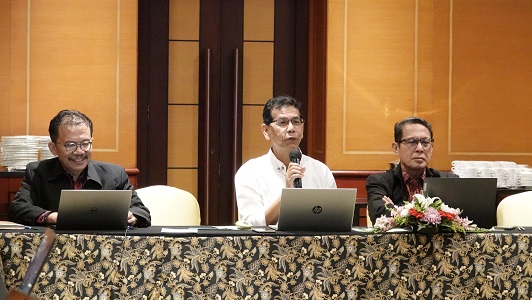
IPB University through the Faculty of Economics and Management together with the United Nations Environment Program (UNEP) and the National Development Planning (Bappenas) held a collaborative project The Economics of Ecosystems and Biodiversity for Agriculture and Food Initiative in Indonesia or Ecosystem Economics and Biodiversity for Agricultural Initiatives and Food in Indonesia (TEEB Agrifood Indonesia).
The case studies in this project focused on coffee commodities in three main regions with different coffee varieties: Robusta coffee in Tanggamus Regency, Lampung, Arabica coffee in Bandung Regency, West Java and Liberika coffee in North Kayong Regency, West Kalimantan.
The TEEB Agrifood Indonesia program was carried out in order to face opportunities and challenges related to environmental and ecosystem factors, climate change, water quality, biodiversity, agricultural management practices, innovation and technology, food security and nutrition, as well as external factors such as international trade.
Preparations for the implementation of TEEB Agrifood Indonesia were first held through 'The First Stakeholder Workshop' activity done at the Borobudur Hotel Jakarta and via online by Zoom, some time ago. This activity aims to inform the TEEB AgriFood program for coffee commodities to coffee sector stakeholders and obtain input regarding the program's strategy and implementation plan.
“It is hoped that Agrifood Indonesia's TEEB study on the coffee sector can provide insight into the practice of developing the Indonesian coffee industry in the future based on the challenges and potentials. This study is also expected to be able to overcome dynamic conditions and ensure sustainability and resilience through adaptive development strategy planning," said Prof Nunung Nuryartono, Professor of IPB University as well as chief researcher of TEEB Agrifood Indonesia.
Thus, he continued, “TEEB Agrifood studies can generate comprehensive knowledge that can guide future investment patterns in the coffee sector. In addition, multi-sector collaboration through Pentahelix is also needed in managing the coffee industry in a sustainable manner. This collaboration is a shared responsibility to support sustainable Indonesian coffee. It is hoped that Indonesia can make fair local trade policies in the future."
At this activity, Ir R Anang Noegroho Setyo Moeljono, MEM (Acting Director of Food and Agriculture of the Ministry of National Development Planning/Bappenas), Barlev Nico Marhehe, SE, MA, MSc (UNEP Indonesia), Martinus Haryo Sutejonoto (PT Surveyor Indonesia) were present. A total of 52 participants consisting of 4 steering committee members, 30 representatives from related agencies and 18 TEEB Agrifood Indonesia researchers.
The 30 representatives of these institutions consisted of national and regional institutions, coffee-related industries and non-governmental organizations (LSM) that focus on the development and sustainability of coffee in Indonesia. Other participants were coffee industry players, coffee market associations and academics. In this case, participants discussed current issues related to the upstream and downstream sectors of coffee at regional and national levels. (*/Rz) (IAAS/SHY)

