
Dolva: Crystal Guava Dodol Innovation by KKN-T IPB University Students in Tanggulangin Village
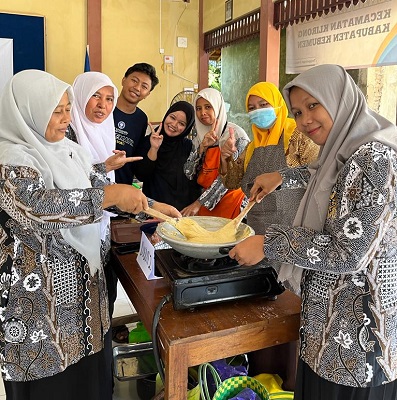
The IPB University Innovation Real Work Lecture (KKN-T) student group in Tanggulangin Village, Klirong District, Kebumen Regency, Central Java held a socialization on making Dolva or guava dodol made from crystal guava. This socialization was attended by members of the Family Welfare Empowerment (PKK) of Tanggulangin Village with direct practice of making crystal guava lunkhead.
This activity was carried out by IPB University Innovation KKN-T students in order to optimize the potential of crystal guava that had not been properly developed. The dolva innovation is also an effort to increase the sale value of crystal guava in the Tanggulangin Village area.
The Dolva processing activity began with an outreach about the processing of guava dodol which was filled in by IPB University Innovation KKN-T students. The socialization was also enlivened by a dodol cooking competition by village PKK women.
“Crystal guavas in Tanggulangin Village are not utilized optimally due to the low selling price, so many of them just rot. In fact, the selling price of crystal guava once touched a nominal Rp. 1,000/kg when the harvest was so abundant," said Susi Susanti as a Tanggulangin Village official who also attended this activity.
Concerned Ika Wahyuningrum, SPi, MSi as the field supervisor added, the socialization of making Dolva in Tanggulangin Village was one of the innovations by IPB University students regarding the crystal guava problem there. When harvesting, crystal guava production is very high, so it is necessary to diversify postharvest products.
"This shows IPB University's commitment to helping people manage resources optimally by increasing the sale value of crystal guava. The socialization and training on making Dolva aims to provide participants with skills on how to process crystal guava dodol," he said.
Ika hopes that this activity can continue and become one of the potential micro, small and medium enterprises (MSMEs) in the Tanggulangin area.
Anis Muthia, an Innovation KKN-T student from the Faculty of Agriculture Technology (Fateta) as the person in charge explained that this activity began with selecting a suitable crystal guava to make dodol. As the main ingredient for making dodol, the choice of crystal guava can affect the taste of the resulting dodol.
"Furthermore, the selected guava is refined before adding supporting ingredients such as flour and food additives. After the mixture is thoroughly mixed, then it is cooked in a cauldron over low heat for about three hours,” commented Anis explaining the process of making Dolva.
The socialization and making of Dolva activities were followed enthusiastically by the contest participants. One of them, Ruminah as the head of the Tanggulangin Village PKK team. According to him, this training is very useful for the community. He and the residents of Tanggulangin Village have come to understand how to make dodol from crystal guava, because so far crystal guava has only been consumed directly without processing it first.
“Therefore, we are very excited to participate in this activity. "Hopefully Dolva can become one of the MSME products of Tanggulangin Village to improve the people's economy," he said.
Iqbal Jayusman who is also an Innovation KKN-T student added, the plan is for a similar program to continue. He hopes to collaborate with related parties in the future.
"Thus, the problem of crystal guava fruit that is not utilized optimally can be reduced and has a positive impact on the people of Tanggulangin Village, both economically and skillfully," he said.
Apart from Iqbal and Anis, other IPB University students who are currently conducting Innovation KKN-T in Tanggulangin Village are Anis Maghfirotul Ulya, Silmi Nurhaeni, Sulis Andriyanto, Ahmad Irfan Marzuqi, Nawang Mega, Trian Dhiaulhaq and Talia Arisanti. (*/Rz) (IAAS/AMR)

