Discussion on the Horizontal Village Economic Integration System for the Nation’s Food Industry, Working Together with PSP3 IPB University, AIPI and KIPD
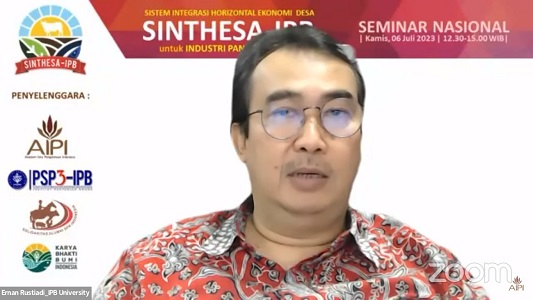
Center for Agricultural and Rural Development Studies (PSP3) IPB University in collaboration with the Commission for Basic Sciences (KIPD) and the Indonesian Academy of Sciences (AIPI) held a national seminar entitled 'Horizontal Economic Integration System of Villages for the Nation's Food Industry (SINTHESA IPB)' on Thursday (6/7) in a hybrid manner at the National Library Building, Central Jakarta.
Chairman of AIPI, Prof Daniel Murdiyarso said, this activity was the right step in the post-pandemic period so that the enthusiasm of rural communities could increase. This seminar is also expected to encourage farmers and breeders towards a productive activity based on science.
"We also want to try to push this aspect of acceleration so we can accelerate the lag that has occurred during the pandemic. I on behalf of AIPI welcome this event with the hope that this forum can work with anyone, one of them is PSP3 IPB University," said Prof Daniel.
Prof Ernan Rustiadi, Vice Rector of IPB University in the field of Research, Innovation and Agromaritime Development who was present at the activity said that there had been significant developments in rural development. One of the things that is important and is the forerunner of the village law is the imbalance between villages and cities.
"IPB University has PSP3 and presents innovations from the People's Animal Husbandry School (SPR) which have been initiated and spread across various regions in Indonesia. IPB University is also collaborating with various parties to be able to develop SPR so that they can assist the farming community in the field," he explained.
He continued, the new concept titled SINTHESA-IPB is a continuation of the SPR and was introduced at a national seminar in collaboration with IPB University, AIPI, Bank Indonesia Employee Welfare Foundation (YKBBI) and Alumni Solidarity of People's Animal Husbandry Schools (SASPRI).
"Through this seminar I really hope that thoughts and stakeholders in the field of animal husbandry can provide improvements to be developed in the community," he said.
Prof Muladno, Chairman of PSP3 IPB University on that occasion discussed the implementation of SHINTESA-IPB and its development in Indonesia. In his presentation, Prof Muladno invited breeders and farmers to do business collectively to make it more effective.
"In SPR for a certain period of time, breeders are given knowledge so that when they graduate they can become entrepreneurs. Then, at SASPRI we also take care of SPR alumni so that the knowledge they have gained doesn't just fall away, they are included for certification until they are independent so they can become entrepreneurs," he said.
He explained, later it is hoped that farmers can become producers of food/feed ingredients. Meanwhile, breeders can become live livestock/meat/fertilizer producers collectively in the countryside, so that it will have an impact on the community. One of the impacts is that the efficiency and productivity in agricultural and livestock business in rural areas is higher, because the scale of business is large and supported by science and technology (iptek) to open business opportunities in rural areas, so as to prevent urbanization.
There were three speakers who attended, namely Drs Sokhiatulo Laoli, Chairman of the YKBBI Board of Trustees and Regent of Nias for the 2011-2021 period; Dr Andriko Noto Susanto, Deputy III for Consumption Diversification and Food Safety, National Food Agency; and Prof Jatna Supriatna, Chairman of the AIPI Basic Science Commission. The activity was also moderated by Dr Bramada W Putera, IPB University lecturer from the Department of Animal Production Science and Technology (INTP), Faculty of Animal Science. (Lp/Rz) (IAAS/SHY)