
BPKB Initiates Sustainable Campus Discussions Through the IPB Sustainability Forum
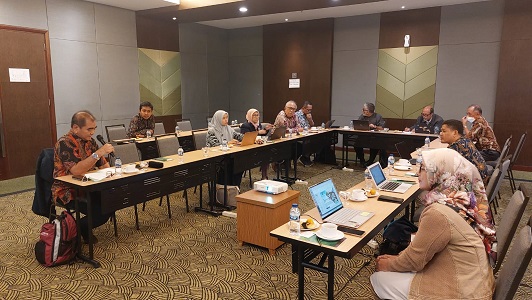
IPB university through the Sustainable Campus Development Board (BPKB) held a Focus Group Discussion (FGD) of the IPB Sustainability Forum. This activity aims to capture ideas, concepts and thoughts related to a sustainable campus, especially in the fields of education, research and community service, which will be accommodated in the form of the IPB Sustainability Forum (ISF).
The Chairman of BPKB IPB University, Dr Ibnul Qayim said, to support the implementation of the ISF requires a lot of input from various fields. According to him, many IPB University lecturers are at the forefront in mainstreaming this sustainability action.
“This BPKB will become a vehicle for discussing sustainability issues in the form of thematic group discussions on issues. Hopefully the contribution of ideas can benefit all of us and we can formulate follow-up implementation,” he said during his remarks at the IPB International Convention Center (IICC), Bogor (27/7).
Meanwhile, Vice Head of BPKB IPB University in the field of Sustainable Campus Reputation Development, Dr Rina Mardiana said that BPKB has the task of planning and developing a sustainable campus in enhancing reputation and realising a socio technopreneur university according to IPB University’s long-term plans.
“In achieving sustainable development goals, it is necessary to provide strategic directions and designs for developing sustainable campus programs and achieving the Sustainable Development Goals (SDGs),” she said.
Furthermore, Dr Rina said that reputation refers to the perceptions, opinions and images that a person, an organisation, a product or a brand has in the eyes of other people. According to him, reputation can be built through long-term interactions with multi-stakeholder people and institutions such as the academic community, customers, business partners and the general public.
“For sustainability, reputations can be formed and influenced online through reviews, ratings, comments and discussions on social platforms and websites. Therefore, maintaining a good reputation through effective communication, careful brand management and collective action for sustainability is becoming increasingly important in a digitally interconnected environment,” she said.
Dr Rina said that regenerative governance is a way to ensure sustainability which is manifested in every policy, development plan and program implementation.
“Regenerative governance shows that our program does not just carry a sustainability narrative, but we have entered a deep philosophical level. Therefore, we need a policy area and guidelines that will be downstream in the SDGs actions,” she said. (dr/Rz) (IAAS/Res)

