SKHB IPB University Refreshes Antemortem and Postmortem Examination Practices for Animal and Sacrificial Meat Health Examiners
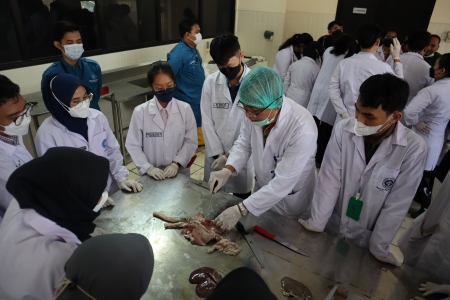
IPB University's School of Veterinary Medicine and Biomedical Science (SKHB) equips health inspectors for animal and sacrificial meat with skills (practical) for antemortem and postmortem examinations. This debriefing at the same time complements theories that has been given before.
This skill is needed when examining animals and sacrificial meat in conditions of the presence of foot and mouth disease (FMD), lumpy skin disease and raise alert against peste des petits ruminants. The practice of antemortem and postmortem examinations was attended by 105 students of the Undergraduate Program and Professional Veterinary Education (PPDH) with 8 SKHB IPB University lecturers as instructors. The activities were carried out in two locations, namely the Teaching Animal Hospital and the SKHB IPB University Poultry Slaughterhouse Room.
"One of IPB University's SKHB efforts to guarantee that examiner officers who will be sent to the community have good abilities in antemortem and postmortem examinations, namely by providing training," explained Dr Herwin Pisestyani as the chief executive of the event.
"Debriefing in the form of practice complements the theoretical debriefing that was done the previous day. With these two types of teachings, SKHB IPB University's sacrificial officers are expected to be able to check the health of animals and sacrificial meat properly and correctly, so the meat from sacrificial animals that will be consumed by the public is guaranteed to be safe, healthy, intact and halal," he added.
Practical activities carried out in one session. Students are divided into small groups, each consisting of ten students and accompanied by one lecturer. Each student participates in two practical activities, namely the practice of antemortem examination in the field and the practice of postmortem examination in the laboratory room.
"We are very helpful with this debriefing. This debriefing emphasizes methods and practices related to examining sacrificial animals in the presence of several diseases that have been epidemic, such as FMD and lumpy skin disease, before going to the field," said one of the student participants. (AP/Rz) (IAAS/BKU)