
Celebrating Eid al-Adha, Halal Science Centre IPB University Holds Qurbani Animal Management Training in 2023
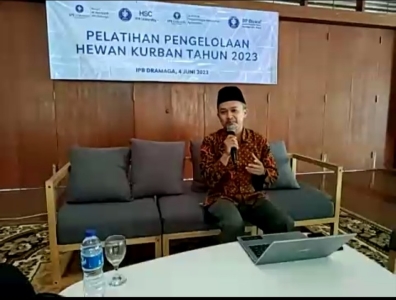
Eid al-Adha is getting closer. To increase the capacity of sacrificial committees and administrators, Halal Science Center (HSC) IPB University recently held a hybrid Qurbani Animal Management Training 2023 at Al-Hurriyah Mosque, IPB Dramaga Campus, Bogor.
This training presented three experts in sacrificial animal management from IPB University, namely Prof drh Agus Setiyono and Dr drh Supratikno from the School of Veterinary Medicine and Biomedical Science (SKHB) IPB University and M Baihaqi, SPt, MSc Agr from the Faculty of Animal Science.
Participants who attended and registered came from various villages around the campus and online more than 500 participants from all over Indonesia. The participants received materials related to the theory and practice of handling and managing sacrificial animals according to the standards of the livestock service office and Islamic law.
“This training is important because in daily practice, there are still many things that are not in accordance with Islamic law. For example, good actions to sacrificial animals and the use of equipment and implementation according to Sharia,” said Head of HSC IPB University, Prof Khaswar Syamsu in his speech.
Prof Agus explained about the sharia of sacrificial worship and animal health. He highlighted that the technical implementation by the community in the field is still not in accordance with standards such as in slaughterhouses (RPH). He emphasised that there must be a commitment from the committee from handling to post-slaughter.
“The community is still poorly trained, so they need to be trained so that they can handle sacrificial animals properly so that the meat is halal and thoyib. Even though they are not animal health workers, the community must also be able to choose healthy sacrificial animals,” he explained.
According to him, the committee or caretaker of sacrificial animals must be observant in recognising signs of diseases such as foot and mouth disease (FMD) or lumpy skin disease (LMD). Examination must be done carefully, because when buying and slaughtering sacrificial animals, they may show different symptoms.
“This can provide an opportunity for the disease to spread to vulnerable animals. Although this disease is not dangerous to public health. However, qurbani must be perfect in terms of age and health,” he explained.
M Baihaqi explained the selection and estimation of sacrificial animal meat and post-slaughter handling. Estimation of sacrificial animal carcasses can be done by visual inspection.
“The percentage of meat or carcass can be estimated from the musculature. But of course it depends on the size of the skeleton, sex, age and condition of the animal,” he explained.
Post-cutting carcass handling must also be hygienic and done as soon as possible so that it does not deteriorate quickly and become a source of disease.
Meanwhile, Dr Supratikno highlighted the antemortem examination and slaughtering of sacrificial animals. He said that the examination is mandatory because in the midst of a disease outbreak, the principle of traceability is very important.
“In order to keep sacrificial animals from outbreak areas from contracting diseases and transmitting them to vulnerable animals,” he said.
In addition, he continued, sacrificial animals must have complete health certificates and show the characteristics of healthy animals. The handling must prioritise animal welfare. (MW) (IAAS/RUM)

