Prof Muladno Recommends Sinthia Broiler to Deal with the High Demand for the Months of Ramadan and Eid
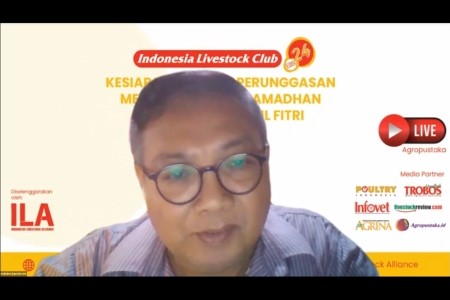
Approaching the moments of religious holidays, the Ramadan month and Eid al-Fitr, it is not uncommon for prices of staple goods, including chicken meat and eggs to increase. Prof Muladno as Professor at IPB University recommends an integrated and transparent supply-demand control strategy, by building a Horizontal Integration System for the Broiler Chicken Industry (Sinthia).
The Head of the Center for Agricultural and Rural Development Studies (PSP3) of IPB University thinks that Sinthia Broiler can be a solution to solving serious poultry problems worth trillions of rupiah. According to him, the key to Sinthia Broiler lies in a community-based chicken farming company as a source of improvement.
"After uniting, horizontal integration must be with Parent Stock (PS) companies and working with feed mills," he said at the 25th Indonesia Livestock Club (ILC) with the theme 'Readiness of the Poultry Industry in Welcoming the Month of Ramadan and Eid al-Fitr which was held on a regular basis online by the Indonesian Livestock Development Agency (BPPI) and the Indonesia Livestock Alliance (ILA), (22/3).
In this system, he continued, business actors ranging from aquaculture, Poultry Slaughterhouses (RPHU), and cold storage must work hand in hand. This program will run when accompanied by universities and district or city governments.
According to Prof Muladno, Shintia Broiler can be a solution to the problems of the poultry industry so far. The reason is that the poultry industry is growing rapidly, but there are many imbalances between companies and smallholder breeders.
“The accuracy and synchronization of chicken production data are still being debated. This means that the crisis of trust among stakeholders still exists. Sales distribution channels are still long and very conventional," he said.
He said the chicken trade system applies equally, both to smallholder farmers and large livestock companies. "It is because the poultry business actors run separately and are only concerned with each other, so it is difficult to unite," he added.
Apart from that, said Prof Muladno, smallholder breeders are still competing in the same market as big companies. Government regulations made at the suggestion of business actors are often barren or do not work. Business actors also maximize the role of local government, sometimes it is even considered non-existent.
"The non-corporate poultry business model is also not in accordance with current conditions, smallholder breeders must begin to transform into companies, small breeders must be brought together to unite as a collective mutual cooperation company," he said. (IAAS/HAP)