IPB University Prepares Educational Staff for Functional Position
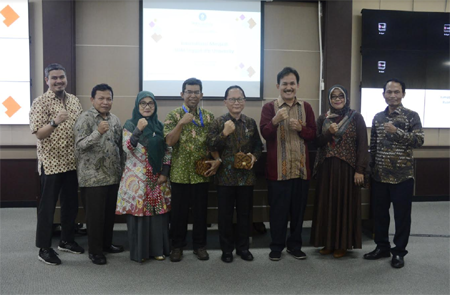
The Directorate of Human Resources (HR) of IPB University prepared hundreds of teaching staffs to occupy functional positions through the Internalization of Institutional HR on Friday (10/1) in the Senate Meeting Room, Dramaga Campus of IPB, Bogor. The internalization is intended so that the educational staffs have the competence and qualifications for the same purpose. Although the tasks in the units are different, they are still in one institution of IPB University.
The Director of Human Resources, Dr. Titik Sumarti, shared that the internalization activity of becoming IPB University's Superior HR was an effort to build togetherness in early 2020. These efforts are in accordance with the IPB University Rector's Program that seeks to create engaged competent human capital.
Dr Titik added, 2020 was a year of engagement in competent of human capital. Through this internalization, it is hoped that IPB University employees are equally heading towards competent human capital which is part of IPB University.
In IPB University, there are currently 1282 educational staffs. This number was gained after mapping 300 employees, who are in the age range under 50 years, so that they are potential for occupying functional positions. The other employees are aged 55 years and over, although in the future they will also hold functional positions.
"This is a challenge in 2020, the initial task of IPB University is to increase competence through a shared culture into dignity human capital. By holding this activity, it is expected that every employee, who is part of IPB University placed anywhere, will be proud of his competence. This is because the capacity of employees has been much more excel through careers in the form of functional positions. It is expected to achieve three words: equity, fairness, and deliver to employee welfare," said Dr. Titik.
Dr. Ahmad Jalis, MA, Head of the Center for the Development of the State Civil Apparatus said that related to the strategy of developing the state civil apparatus (ASN) in improving agency performance.
He said that the training was not part accumulating knowledge, but did not have any impact on the agency. Training is not just to form competencies but also improve agency performance.
"Mostly what happened is that the person sent is the wrong person. Wrong address, wrong person. Many employees often had assignments and get modules, but did not produce anything at work. I am sure this did not happen at IPB University," he said.
He admitted, efforts to form competencies were not easy. Because the work behavior must be observable and measured from knowledge, skills and attitudes.
Therefore, training must be measured. Measuring competencies of participants cannot be done from their knowledges pnly. Ahmad Jalis admitted that his team was currently evaluating the training that had been carried out. His team wants training produce not only competent employees, but also to have an impact on organizational improvement.
"There must be added value, starting from the human capital base and increasing the potential of the employees. The training carried out also does not have to be homogeneous, can be diverse and unique to each individual. This is because there are skilled employees but their knowledge is lagging," he added.
Meanwhile, Sunarto, Head of the Technical and Functional Education and Training Division, Ministry of Education and Culture Ministry of Education and Culture delivered related training strategies for functional career development. He said that functional positions were extraordinary. the impact of being in functional position was far exceeded than being a structural employee. Because through functional positions, the employees will change a lot both in terms of work culture and competence. (/IAAS/AKD)