
Islamic Economics Important Role and Implementation Support Sustainable Agriculture SDGs
Agriculture has an important role in the economic development of Indonesia. Agriculture as a producer of food and nutrition for the public to absorb 31.86 percent of the total workforce in Indonesia in early 2017. Based on data from the Central Statistics Agency (BPS), the sector is also contributing to 13 percent of Gross Domestic Product (GDP) of Indonesia in 2017.
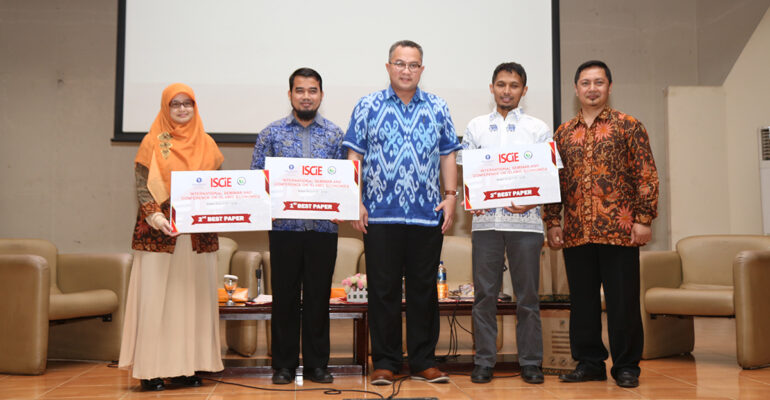
It is presented by Dr. Sutan Emir, SP, MBA, Director of Education and Research of the National Committee of Islamic Finance Islamic Finance (KNKS) who attended the International Seminar and Conference on Islamic Economics (ISCiE) 2019, Tuesday (6/8) at the Auditorium Andi Hakim Nasution, Kampus DRAMAGA. This event was held in collaboration of two units in IPB University namely the Department of Islamic Economics and the Center for Islamic Business and Economic Studies (CI-BEST).
"Indonesia has a strong commitment to realize the target 17 Sustainable Development Goals (SDGs), by integrating them into the National Medium Term Development Plan (RPJMN) and in line with the six priority agenda nawacita President Jokowi," said Dr. Sutan.
Promoting the theme of Islamic Economics in Agricultural Development and Sustainable Development Goals (SDGs), Dr Sutan said that Islamic economics has characteristics that can support the objectives of SDGs. Islamic economics has a number of financial instruments that are social, call it charity, donation, charity and endowments. As for agriculture, such as mudaraba Islamic financing agreement, Musharaka, muzaraah, musaqah, bai 'salam and murabaha are some contracts that could provide a solution for the farmer.
"Total land endowment in Indonesia reached 4.4 billion square meters spread over 400 thousand areas. However, the total area certified is still 66 percent of its potential. Still needs to be optimized. Endowments productive agricultural uses, can empower the local economy and support the environment, "said Dr. Sutan.
Dr. Sutan pointed out, Yayasan Al Azhar Indonesia has planted trees Jabon as endowments, and the results from it a profit of 750 million rupiahs per six years.
While Asst Dr. Muhammad Abduh, Program Leader of Accounting and Finance, School of Business and Economics, Universiti Brunei Darussalam stated, other instruments that Islam had to realize the goal SGDs to end hunger, achieve food security and better nutrition and sustainable agriculture are Ihya al-Mawat ,
Ihya al-Mawat is to revive the dead land or put a piece of land that is not used to be used by an individual and property rights over it. In general, Mawat land refers to land that is ignored and not cultivated for at least three years.
"The bottom line is this in the public interest, not the interests of individuals. So, Mawat land given to those who can transform into a dead land productive factor in society, "said Muhammad Abduh.
Dr. Laily Dwi Arsyianti, Secretary of the Department of Islamic Economics IPB University also emphasized in his speech that the Islamic economy has the potential to play a transformative role in supporting the implementation of SDGs agenda.
"Conceptually, objectives and targets in line with the mandate SDGs Islamic economics derived from sharia objectives, namely maqashid al-Sharia. Agricultural development is closely related to Islamic economics because its strength lies in the real economy, and its vital role in achieving almost all components maqashid al-Sharia, "said Dr. Laily.
IPB Rector of the University, Dr. Arif Satria, who also gave a speech at the seminar, explained that in the current era, we are faced with the challenges filled with volatility, uncertainty, complexity and ambiguity (VUCA).
"I think this is a challenge for us all, especially for Islamic economics with the presence of new technologies, any economic activity is now running with the financial technology (fintech)," said Rector.
Then Dr. Arif stated that communication, collaboration, critical thinking and creativity is a very important skill to have. Because in this era is the time to create synergy, improve collaboration in order to face the changes.
Also present as a speaker at the event, Prof. Yusman Syaukat, Bogor Agricultural University lecturer, Assoc. Prof Dr Salina Kassim, International Islamic University Malaysia, M Rifki Ismal, PhD, Assistant Director of the Department of Economics and Finance Sharia Bank Indonesia (BI), Umar Munshi, co-founder of ethical Group, as well as Kalla Buana, Islamic Finance Specialist United Nations Development Program (UNDP). (AVR)

