Key Collaboration on Advancing Indonesian Livestock
Along with the increasing population on earth, especially in Indonesia, the need for meat and protein is also increasing. This situation is a shared challenge for the Indonesian people in order to realize national food sovereignty.
On the other hand, the recent stunting issue has also become a polemic. This is because nutritional consumption in the community is still lacking.
Professor of the Faculty of Animal Husbandry, IPB University, Prof. Dr. Ir. Luki Abdullah, M.Sc, explained that demand for meat in 2030 is projected to increase to 80 percent and in 2050 the demand for meat can increase by more than 200 percent.
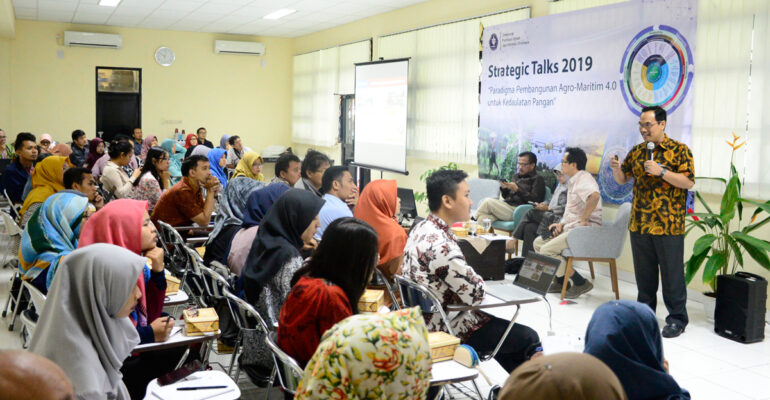
"This is indeed an opportunity that must be utilized, but our production capacity is still lacking. At present our farms are dominated by people's farms, so let's collaborate together, "said Prof. Luki at the Strategic Talk Discussion with the theme "Sustainable Livestock Production for Food Sovereignty," Friday (7/19), at Dramaga Campus, Bogor.
Prof. Luki also explained, in today's digital era, livestock products are all demanded to be faster, more precise, smarter, and more efficient at reaching consumers. In order to survive, there needs to be integration between feed providers, livestock pens, and processing of livestock. The use of technology and mastery of business networks must be improved in order to facilitate access to capital.
"Implementation of this concept must be carried out in a multidisciplinary manner. Transdisciplinary work is currently very much needed because we cannot work independently, computer science people must know about the basic concepts of animal husbandry. Therefore, one another must support each other, "he added.
The same thing was expressed by the Dean of the Vocational School of IPB University, Dr.Ir. Arief Darjanto, M.Ec. "At present we are entering an era of technological development that requires vitality innovation. Going forward, our challenge is how to produce a lot with little input, but the quality is also good. Therefore livestock revolution must also be accompanied by a market revolution, "he said.
Dr. Arief added that in the future there needs to be an integrated business model in developing livestock in Indonesia. Dr. Arief gave an example, in chicken farms, the feeder must be able to cooperate with breeders, breeders, processing, and marketing.
"The partner strategy is currently important, because the current era is the era of coopetition and cooperation," he concluded.
For example, the current integrated business model, Deputy Head of Research, Institute for Research and Community Service (LPPM) of IPB University, Prof. Dr. drh. Agik Suprayogi, M.Sc.Agr explained that IPB University has a School of People's Animal Husbandry (SPR) which has been adopted in several regions.
"The existence of the SPR is an example of direct integration between government, academics and farmers. Therefore, it must be strong in collaboration or institutions, namely how we share the roles and responsibilities in building superior and modern agriculture, "he explained.
Prof. Agik emphasized that all parties must be compact and solid to realize integrated smart farming in Indonesia to answer the challenges of the future. To invite many parties, there needs to be a consolidation between academics, government and business people. (RA / ris)