
IPB Research Team Reveals Results of Untung Jawa Island Ecosystems Research
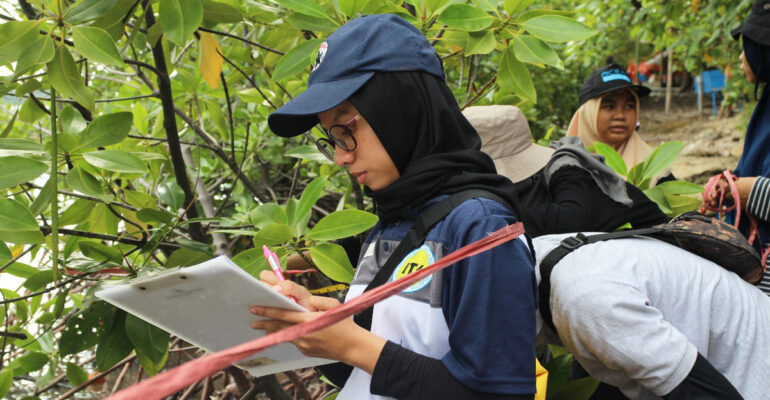
Lecturers and students of the Department of Marine Sciences and Technology (ITK) Faculty of Fisheries and Marine Sciences (FPIK) IPB University carried out a research in Untung Jawa Island, Thousand Islands, Jakarta from 19 to 21 April 2019. This event is part of a series of activities of a lecture course for Marine Biodiversity (KHL) 2019 themed “Urban Coral Reef Ecosystem”. Observations were made on major ecosystems as a benchmark for the state of biodiversity and biodiversity of species on the territory of the visit, the coral reefs, mangroves and seagrass, threats like marine debris, as well as matters related to environmental services.
“Untung Jawa Island is one example that can be categorized as an Urban Ecosystem in the sea because it is adjacent to the mega city of Jakarta,” said Dr. Hawis Madduppa, who is in charge of the KHL course. “The study of urban ecosystems is currently one of the trending studies in the world including in the area of biological diversity ‘,” added the expert’s Biodiversity IPB Sea.
Raihan Hadi Syahputra, a student participating in the activity said that the condition of coral reefs and the diversity of ecosystems in Untung Jawa Island waters is low. Biota which dominates in the region are sea urchins. Many of the ecosystems environment are contaminated with trash and has murky waters. “The state of the coral reefs in the waters of Untung Jawa has a low coral cover. Many find sand, rubble and dead coral on the observation location. We found a small amount of fish and benthic macro. This ecosystem is experiencing quite a lot of pressure from domestic waste and pollution, “he said.
Another participant, Frend Muhammad added that the condition of mangroves in the coastal areas of Untung Jawa are quite good and vary from each species. The density found at the location was sufficiently high, especially in the western part of the island. This is because the region is a place where there are lots of mangrove conservation of mangrove plants that inhabit the location. Species that predominate the mangrove region on Untung Jawa is Rhizopora mucronate.
Meanwhile, Bagus Ade Prasetyo who also participated in the study, said that the condition of the ecosystem in the coastal areas of Untung Jawa is classified as poor. It is caused by factors such as trash and tourism activity. It is quite alarming, where pollution is very influential on the continued growth of seagrass in this region. “Biota associations found in the seagrass were quite diverse including bivalves, sea cucumbers, small fish, sea urchins and flatworms,” he said.
Subsequent observations were the marine debris. Surveillance activities were carried out in the afternoon (19/4) and morning (20/4) in order to analyze the influence of the abundance of garbage. The observation begins with a survey of garbage then measured in its composition density in coastal areas. Based on the survey the abundance of plastic waste in the eastern region is dominated by glass rubbish bins while the density in the southern region is dominated by plastic waste.
Furthermore, the results of this study will be published through various media. “We’re going to make a video documentary, popular science books, photo exhibitions, scientific discussion and scientific journals,” said Dondy Arafat M.Si, who is in charge of the research activities. “By using various media, we hope that the results of the research can reach all layers of life, “The coral reef researcher said. (AVR)

