IPB Increases Community Capacity for International Publication
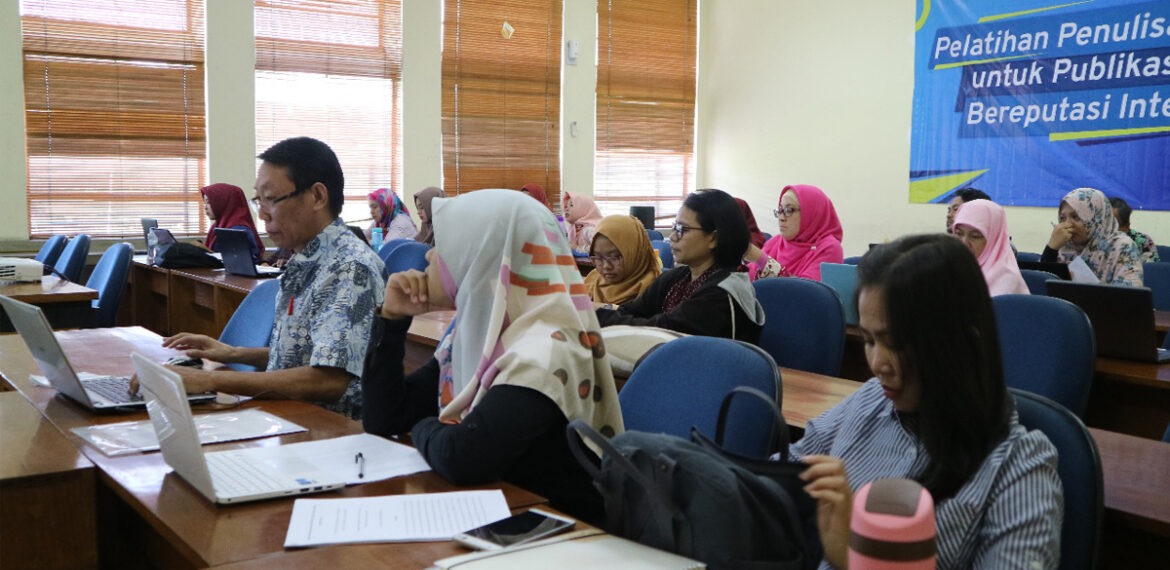
The Directorate of Scientific and Strategic Information Publication, IPB University held a Batch 3 Scientific Article Writing Training, April 9-10 2019. Dr. Mohamad Rafi, Head of Sub Directorate of Scientific Publications encourages participants to have high commitment in writing scientific articles to be published in journals and international reputable proceedings. According to Dr. Rafi, this training activity is to facilitate and conduct further coaching for participants through the IPB Publication House. The articles prepared by the participants were reviewed again by the Home Publications reviewer team to be better. Language editing facilitation through Enago will be given to articles that are eligible to submit to quartile journals Q1 and Q2 Scimagojr. For quartile journals Q3 and Q4 can use the Grammarly application.
“In order for scientific articles to be able to be published internationally, the process is long and not easy. Therefore, journal writers must practice frequently so that they are proficient. And that is not less important, he must be able to highlight the novelty of the research to attract reviewers,” Dr. Rafi.
Director of Scientific Publication and Strategic Information, Dr. In her speech, Eva Anggraini said that currently universities in Indonesia and in the world are competing to improve university rankings (World University Ranking / WUR). This ranking has big implications, for example to improve academic cooperation, research and others, attract foreign students, and others. Therefore, IPB inevitably participates in increasing the ranking of universities in the world in order to have good competitiveness. “One of the backbones of World University Ranking (WUR) is scientific publications. If viewed from the weight of QS WUR, one of the world’s ranking systems, scientific publications provide a weighting value of 20 percent, judging from the number of citations obtained. In order to have high citation, it is expected that lecturers and students can publish their articles in reputed international journals with high impact factors. In terms of numbers, the proportion of IPB articles published in indexed journals is still dominant (55 percent) than those published in indexed proceedings. While the current trend of many other universities publish their articles in indexed proceedings. “IPB is currently encouraging to maintain quality and also increase the quantity of scientific publications,” said Dr. Eva.
IPB realizes that the process of writing scientific articles is not easy and instant, so there is a need for writing training for scientific publications continuously. IPB has established a Publication Clinic since 2017 and is transforming into a Publication House to provide comprehensive services ranging from article preparation to publication. Another thing that is planned in the near future is to subscribe to the online module for writing scientific articles from Springer Nature which can be accessed online by the IPB community members. Furthermore, IPB will combine conventional training with online training so that the increase in lecturer and student publication capacity can run more effectively. The activity that presented Dr. Muhamad Taufik, Dr. Nancy Dewi Yuliana, and Dr. Berry Juliandi was participated by 32 participants consisting of lecturers and students of the IPB Postgraduate School.
Training material includes structure and illustration manuscripts, ethics in scientific writing and peer review and correspondence: an editor’s perspective. In this training there was also a coaching clinic for participants. (* / ris)