IPB Student Advocates Food Security in Ciapus Village
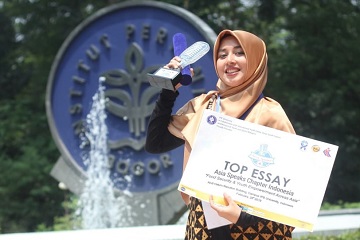
Arnita Rodelina Turnip, Student of IPB University (IPB) advocating solutions related to food security programs in the era of climate change. By using the title of the Sustainable Food Security in Developing Country under the Climate change in Indonesia, Arnita analyzes the management of the increase and the economic growth rate of rural communities through several social work programs in collaboration with Ciapus Village, Bogor Regency. This was presented by Arnita in ASIA Speak Chapter Indonesia.
ASIA Speak Chapter Indonesia is an Asian Youth activity between the ages of 17 to 25 years from ten member countries of ASEAN and ASIA. Participants are expected to make changes by providing a platform for learning, contributing and advocating for solutions to solve the problem of food security and empowerment of youth throughout Asia.
Some of Arnita’s suggestions were expressed in efforts to food security in the climate change era of Ciapus village, Bogor Regency. One of them is advising that they can prioritize the management of the use of appropriate technologies such as the development of harvest and postharvest machines, especially grain drying and grinding systems. “Information about integrated agriculture, given that Indonesia entered the industrial era 4.0. Because agricultural sector is very susceptible to climate change that affects cropping patterns, planting time, production, and quality of yield. Another effort that can be done through food crop adaptation is by managing land and water resources optimally sustainable, managing plants that are adapted to local climate conditions, using effective and efficient agricultural production facilities, and implementing adaptive agricultural technology that is effective, “said Arnita.
Three diversified productions that Arnita will do; First, diversification of direct and indirect agricultural products in the village of Ciapus. Second, horizontal diversification that develops superior commodity agriculture as the “core business” and develops other commodity agriculture as a complementary effort to optimize the utilization of natural resources, capital, and family labor and minimize the risk of business failure. The third regional diversification is developing superior location-specific agricultural commodities in a large area in accordance with its agroecosystem, thereby encouraging the development of agricultural production centers in Ciapus Village.
“I see there is a demand for socialization of farmer groups or climate field schools (SLI) to produce, process and communicate climate information to determine the agricultural systems, cropping patterns, and the most profitable technology with the least risk,”Said Arnita.
The importance of the agribusiness approach to strengthening the economy and institutions of farmers in the agricultural sector is also important. This approach integrates upstream and downstream activities vertically and horizontally in various sectors as to create decent profits for farmers.
In addition, the agribusiness institution that needs to be developed are village-owned companies (Bumidesa), Farmers Groups (Gapoktan), Women’s Farmers Groups (KWT), Water-User Farmers Association (P3A), cooperatives and rural financial institutions, providers of production facilities and infrastructure, marketing of agricultural products. Furthermore, Arnita said that it was necessary to empower field extension workers who mobilized the community in joint activities, fostering and increasing the role of the community. “Meanwhile, the village’s cooperative unit (KUD) has the role of helping its member farmers in obtaining credit, production facilities and agricultural equipment and accommodating and marketing the results,” said Arnita. (jhn)