
BKKBN Cooperates with IPB in Successing Making Indonesia 4.0
The National Population and Family Planning Board (BKKBN) considers that it is necessary to make Making Indonesia 4.0 successful. In this era of industrial revolution 4.0, changes in the strategic environment affect the role of families, communities and the world of education in educating and growing the value of national character.
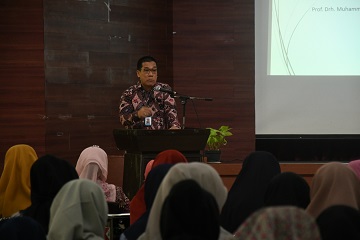
This was conveyed by Prof. Rizal Damanik as Deputy for Training, Research and Development of BKKBN, during Dissemination of Research Results in the Population, Family Planning and Family Development (KKBPK) at the Auditorium of Community Nutrition and Family Resources (GMSK), Faculty of Human Ecology (Fema), IPB Dramaga Campus, Bogor (21/12).
This activity was held as a form of collaboration among BKKBN, the Institute for Research and Community Services (LPPM) of IPB and Fema of IPB.
According to this Professor, BKKBN is developing cooperation on the research program with university partners throughout Indonesia and one of them is IPB. IPB as one of the universities that has carried out the KKBPK research indeed has an obligation to socialize the results of its research for the interests and benefits of the community, especially for the family.
“The collaboration with IPB continues to be improved because IPB has departments such as the Department of Community Nutrition and the Department of Family and Consumer Sciences which are directly related to BKKBN duties and functions. We can jointly improve the development of education and health of families and communities,” he added
Meanwhile, Deputy Head of LPPM of IPB for Strategic Studies and Scientific Publication, Dr. Eva Anggraini said that this activity was a good collaboration between IPB and BBKBN to conduct research dissemination activities. IPB itself is currently pushing for research and innovation for IPB 4.0.
The characteristics are high-precision agromaritime through the use of drone technology, artificial intelligence in the upstream agricultural and marine sectors, agro-industries for the future, and digital agrologistic systems. For community service, IPB has a concept of community service 4.0 that encourages the downstreaming of innovations which become solutions for communities, industry and government.
“The direction of Agro-Maritime 4.0 transformation is to realize the recovery of agro-maritime ecosystems, new agro-maritime management that is inclusive, equitable, efficient and prosperous, sovereignty of food and non-food production, competitive agro-maritime industry and balanced agro-maritime value chain between regions, and strengthening human resources,” she said.
She added that in Agro-Maritime 4.0 social aspects must be considered. Family is one of the most important units so that digital technology does not have a negative impact on family development, especially children. The family is the first and foremost forum in nurturing and educating children in order to develop the essential values that form the characters of the nation.
Three researchers from the Department of Family and Consumer Sciences of IPB, Dr. Tin Herawati, Dr. Dwi Hastuti and Dr. Ir. Lilik Noor Yulianti, and a lecturer at the Department of Communication and Community Development (SKPM), Dina Nurdinawati, M.Si, attended this activity. (Awl/Zul/ZSP)

