
More than 500 Writers from 9 Countries Attended IPB’s PKSPL International Conference
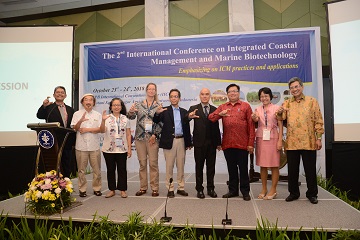
The Center for Coastal and Ocean Resources Studies (PKSPL), the Institute for Research and Community Service (LPPM) of the Bogor Institute of Agriculture (IPB) hosted the 2nd International Conference on Integrated Coastal Management (ICM) and Marine Biotechnology: Emphasizing on ICM Practices and Applications. The event was held at IPB International Convention Center, Baranangsiang IPB Campus, Bogor (23-24 / 10). The conference involved 544 authors from Indonesia, Germany, Malaysia, Australia, the United States, France, South Korea, Thailand, the Philippines in 125 abstracts or presentations.
Vice Rector for Cooperation and Information Systems of IPB, Prof. Dodik R. Nurrochmat said that since the 1990s, IPB through PKSPL has developed techniques and methods that have a large role related to the management of coastal and marine natural resources, especially in the fields of coastal and marine biotechnology, coastal and marine spatial planning, mitigation climate change and impact adaptation, pollution reduction and coastal and marine mitigation, maritime transportation and port management, ecosystem management approaches to fisheries, blue economy and coastal and marine social and economic aspects.
As a pioneering scientific institution in coastal and marine science in Indonesia, IPS PKSPL has produced a number of tools and methods applied in Indonesian coastal and marine management. For our country, it is important and a challenge, because we are home to mega-biodiversity in the form of coral reef ecosystems, mangrove ecosystems, seagrass beds, estuaries located around 17,506 islands and 91,000 km along the coast, " added Prof. Dodik R
In addition, according to Prof. Dodik R, IPB's PKSPL has also been designated by the Partnership in Environmental Management Program for The Seas of East Asia as an ICM Learning Center for Indonesia. Developing scientific tools is one of the main tasks of the ICM learning center and to help develop local ICM learning centers in each local location throughout the country. In the regional scheme, IPB's PKSPL has been involved in various regional schemes and programs related to coastal and marine management and development.
Prof. Tridoyo Kusumastanto, Chair of the IPB Academic Senate who is also an expert in the field of coastal and marine resources expressed the importance of adopting integrated coastel management. Indonesian coastal and marine areas have significantly contributed to the development of marine economic development which is associated with seven economic sectors. namely fisheries, marine tourism, maritime industry, energy and minerals, shipping, marine construction and marine services.
"Marine economy is the backbone of Indonesia's maritime development. The contribution of the economic sector has increased Gross Domestic Product (GDP) from 22.42 percent in 2005 to 28.34 percent in 2015. The development of coastal and marine areas has shown the impact of degradation caused by natural factors and human-caused factors such as pollution and unsustainable resource exploitation, "added Prof. Tridoyo.
According to him, these two factors will disrupt the flow of goods and services and will ultimately reduce the sustainability of maritime development. The application of "blue economy" policies is needed to achieve sustainable use of ecosystems and resources for marine economic growth while maintaining the environment, reducing the threat of sustainability in maritime development.
Meanwhile, Prof. Dr. On the occasion, Rokhmin Dahuri, Minister of Maritime Affairs and Fisheries of Indonesia from 1999 to 2004, said that entering the Industrial Revolution 4.0 era, Indonesia is currently at a crossroads. On the one hand, there is an unavoidable need to increase the use of natural resources and environmental services that are realized in coastal and marine areas to meet increasing human demand. For example food, clothing, medicines, building materials, energy, and minerals and land space for housing, industry, agriculture, tourism, and infrastructure.
In addition, the use and development of natural resources and coastal and marine environmental services have also been used as a means to generate economic growth and employment opportunities to improve people's prosperity. Changing their status from developing (poor or middle) countries to high-income countries. The use and development of natural resources and the services of the coastal and marine environment will certainly increase in line with the increase in the human population and standard of living. As well as the fact that natural resources and environmental services on land (terrestrial ecosystems) become scarce or difficult to develop.
" we are also faced with pollution, overfishing, destruction of physical habitat, and other environmental damage that has reached a level that threatens the sustainability of coastal and marine ecosystems that lead to unsustainable coastal and marine development. Sadly, this pattern of industrialization and development has also caused the majority of fishermen, fish farmers and other coastal communities to remain poor. And the gap between rich and poor (income inequality) in this coastal region is also high, "said Prof. Rokhmin.
In short, most problems such as pollution, overfishing, loss of biodiversity, and other environmental damage associated with economic development on earth including in the coastal zone are the result of putting too much pressure on limited natural resources. A condition known as exceeding carrying capacity.
"Therefore, in order to realize sustainable development as the ultimate goal of Integrated Coastal Management, we must maintain and increase the carrying capacity of coastal and marine ecosystems, and simultaneously manage human demand and exploitation of coastal and marine resources so as not to exceed such carrying capacity , " said Prof. Rokhmin. (jhn)

