
There are Only 40 of the 2000 Cities and Regencies That Use RDTR
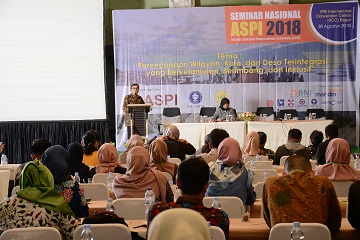
The Center for Regional Study, Planning and Development (P4W) Institute of Research and Community Service (LPPM) Bogor Agricultural University (IPB) in collaboration with the Indonesian Planning School Association (ASPI) and Pakuan University held the 2018 ASPI National Seminar. The seminar with the theme "Sustainable, Balanced and Inclusive Regional, City and Village Planning" was held at the IPB International Convention Center (IlCC), Bogor, (28-30/8).
In this seminar, Dr.Ir. Kamarzuki, M.P.M, Director General of Spatial Planning, Ministry of Agrarian Affairs and Spatial Planning of the Republic of Indonesia (RI) said that there are still a few cities and districts that follow the Spatial Detail Plan (RDTR) and the Regional Spatial Plan (RTRW). RDTR functions as a quality control of district or city spatial utilization based on RTRW, a reference for more detailed use of spatial activities from spatial utilization activities regulated in the Spatial Plan, references for controlling spatial utilization, reference for issuance of spatial utilization permits, and references in the preparation of Plans Building and Environmental Governance (RTBL).
"Of the RDTR needs (2000 cities or regencies for all of Indonesia), only 40 cities or districts have been used. The government has long focused on the creation of urban village linkages. Only the strengthening is in the regional government, the authority is in the local government. In addition, because of the frequent changes in the structure (formerly the Spatial Planning Center was in Bappeda, now it is in the Spatial Planning Office), while the experts did not join in, so this became a problem of its own. The current effort from the center is to strengthen the capacity of Human Resources (HR) in the regions,” he said.
Another obstacle are advanced technology and maps. The key is in strengthening local government, human resources are needed to meet market needs and data. Large-scale maps are also an urgent need. To produce a map is also not easy. Therefore one of the roles of ASPI is to produce competent human resources.
According to the Deputy Chair of ASPI, Dr. Janthy T. Hidayat, ASPI is an organization that accommodates the place for the Regional Planning School in Indonesia. There are around 66 universities that have study planning programs ranging from bachelor, master and doctoral degree that spread from Sabang to Merauke. The aim of the establishment of ASPI is to improve planning science, encourage and develop schools in national and international contexts. "There are 66 study programs owned by ASPI, we can help the government with regard to Human Resource needs," he said.
Prof. Dr. Anas M Fauzi as Dean of the IPB Postgraduate School said that on behalf of the Rector, IPB welcomed this activity.
"There are many regional officials who are alumni of the Study Program for Regional and Rural Development of IPB. With this activity the network can be strengthened. In 2008, IPB established a Regional Development Management Study Program more on applications. In line with that, IPB also launched the Lapan IPB satellite called Lisat. This satellite will circulate in the territory of Indonesia three times a day. This Lisat has produced a lot of data. This micro satellite is to monitor food security and the environment. Data has been acquired for use. We invite the seminar participants if they want to access the satellite image data, "he said.
Meanwhile, according to Dr. Ernan Rustiadi, M.Agr, Head of P4W LPPM IPB, RTDR is to regulate what is permissible and not allowed in spatial planning. Therefore, it is important for post-graduate schools to guard institutions. "There needs to be someone who says from the root about strengthening human resources and root level institutions," he said. (FM)

