IPB Rector Plans Lombok Disaster Response Team
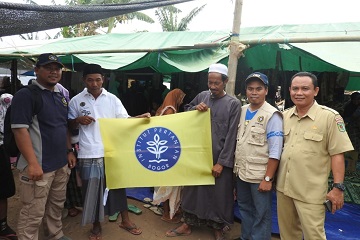
Earthquake that happened on August 5th left deep sorrow for Lombok people. Calm atmosphere became teary one. Thousand houses badly damaged and destroyed. More than 390 people died. Even there was a district that a hundred percent level to the ground.
As the response to that, Rector of Institut Pertanian Bogor (IPB) through Research Institution and Community Service (LPPM) IPB sent Quick Response Team to Lombok. This team was lead by Head of the Center for Disaster Studies LPPM IPB. In this quick response the team was assigned to send assistance to general public, farmers, fishermen and breeders.
Next they would do mapping of disaster-affected areas. Dr. Syamsul Bahri Agus and Muhammad Baihaqi, M.Sc, lecturers of Faculty of Animal Science did observation earthquake impact to breeders, Sekolah Peternakan Rakyat (SPR) areas, and other breeder groups. Fika Hardini from Nutrition and Family Welfare Clinic LPPM did observation to children and mother groups in affected area and Danang Aria project officer LPPM IPB.
In this opportunity, the team immediately mapped the impact on the target area. One of the district target was Genggelang village, Gangga district, North Lombokregency.
Based on the monitoring of the IPB team, the damage was the destruction of residential buildings and the paralysis of the community's economic activities and schools in the vicinity of North Lombok. According to one resident of the Genggelang village, many people choose to evacuate rather than remain at home. Although the house was not too badly damaged, the people still chose to stay in the post because they were still afraid of aftershocks. In conditions like this, there is also frequent power failure.
One of the refugees at the Genggelang village post also said that at the post there were no volunteers in the field of education to their children. A lot of help came but only reduced aid, sometimes food or clothing but rarely came to educate children.
During the field, the IPB team delivered assistance in the form of blankets, drinking water assistance, baby porridge, baby diapers and mats that were delivered directly to the community. In general, the affected people have not dared to return home for fear of aftershocks. So they still hope that in the future there will be assistance in the form of tents or tarps.
In general, a lot of assistance is in the location near the main road, but in the interior the conditions are still limited. From the observations made, several things that need attention in the future include post-earthquake community recovery efforts, sanitation and health. One of the important things in the future is preparing a trauma healing program in the affected location.
The Rector of IPB hoped that the Quick Response team could prepare a rehabilitation, reconstruction scheme to accelerate the resilience of the affected communities. (NR)