Overnutrition Children Problems, IPB Students Relive Traditional Games
The rapid development of technology has various impacts that are considered positive and negative. Advanced technology allows people to access information from around the world. However, the negative impact of technological advances also exists. Often the excessive use of gadgets causes children to become passive and do not perform motion activities. Lack of activity in children can lead to overnutrition that adversely affects the health of the child.
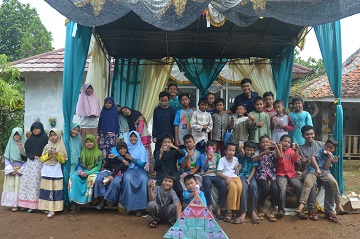
Seeing the case, three Bogor Agricultural University (IPB) students from the Community Nutrition Department, Indra Hermawan, Arif Suprayogi and Nurul Aulia Dewi, modified traditional games for children through the Humanities-Social Research Student Creativity Program (PSH). Accompanied by dr. Naufal Muharam Nurdin, S.Ked, M.Si, the team with the title PKM "From Mager to Bager: Behavior Change Through Modification of Traditional Games In Overnutrition Children Based on Health Belief Model Theory" that invites children in some schools to spend time with traditional game activity.
"The prevalence of more malnourished children in Indonesia is very high and there are two causes, which are food and lack of physical activity. Even based on research from a journal approximately 3.65 times children who are not physically active will be more susceptible to illness than those with physical activity. That is why it is important that we socialize the importance of physical activity for children," said Indra.
By looking at changes in the behavior of overnutrition children, Indra and his team modified some traditional games such as galasin, buai-buaian, jump rope, and engklek. In addition to inviting children to physical activity, through the game also delivered a message about health for children.
"So, we make the game media as a message delivery for healthy living. For example, in a game of buai-buaian we make a pyramid-shaped puzzle that must be prepared and if it is arranged there will be posts related activities that can be done by children with a certain portion of time," added Indra.
Not only activities through traditional games, Indra and his team also use a pedometer to measure the time spent in the activity and know the calories that have been burned. That way, it can be known how important physical activity for children, especially for the health.
Through the modification of this traditional game, Indra and his team hope that their program can increase the motivation of children to do more activities.
"In addition to reducing the number of overnutrition children, our program can also restore the existence of traditional games. Through this game the children are also reminded to grow the culture of silaturrahim," said Indra about the expectations of his PKM program. (RYS)