
AJDEKTRI, Innovation of IPB Students for Bacterial Detection in Drinking Water
Fulfillment of the need of clean drinking water in urban areas is increasing, so that bottled water products are in great demand. However, bottled drinking water is relatively expensive, thus, the refill drinking water products arise due to its more affordable price. Nevertheless, the quality of drinking water presenting in the community needs to be considered microbiologically, as it is potentially contaminated by bacteria such as E. coli and coliform that cause various digestive problems. One of the diseases caused by bad quality of drinking water is diarrhea. Diarrhea is one of the most common diseases in Indonesian society.
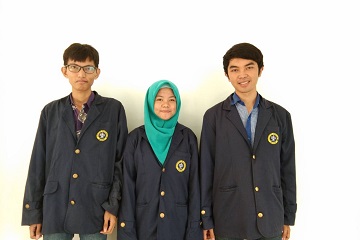
The next problem arisen is the difficulty of detecting bacteria that exist in drinking water efficiently and effectively. Based on that point of view, three students of Bogor Agricultural University (IPB) developed a more efficient and applicable tool to detect the presence of bacteria in drinking water. They designed this interesting innovation in the form of Portable Instrument for Bacterial Detection in Drinking Water (AJDEKTRI). The development of the tool was carried out by the students of the Department of Chemistry of IPB, namely Nunuh Nugraha, Dina Anggraini and Mustofa, under the guidance of Dr. Eti Rohaeti.
Nunuh said that the development of this tool is one of the solutions to detect bacteria in drinking water in more practical and efficient way. Actually there are bacterial detection tools in drinking water such Microbiology Water Test Kit, but this tool is very expensive. The price reaches tens to hundreds of millions. In addition, this tool has a large dimension that is less practical to carry anywhere.
"Therefore, we are trying to create a tool that can detect the bacterial contents in drinking water which potentially cause digestive problems in the form of a portable device. This tool is certainly more practical and can be taken anywhere," he explained.
In addition to practical, the device developed by these three young students is also much cheaper than the tools that already exist in the market. The production cost of this tool is only around 1 million rupiah.
The shape of this tool is also much smaller than the tools on the market. The working principle of AJDEKTRI is similar to that of a spectrophotometer, which detects the content of a substance based on the value of the resulting light absorption. The difference is in the analysis of bacterial content. AJDEKTRI analyses the bacteria content based on their luminescence or fluorescence. The solution used as the test object is fired by monochromatic light to be absorbed by the color detector. Furthermore, the color obtained will be detected by the criteria of the substances present.
To simplify its use, AJDEKTRI is equipped with a software application called Spectral Workbench which is used to analyze the results of bacterial content in the samples of drinking water, so it is suitable for use in the field.
"Its practical form allows this device to be used in the field inspection for testing drinking water materials directly," he explained.
The future prospect of the implementation of this tool is to help public health quality service institutions to check and monitor the quality of water in the community. (UNA/ZSP/Zul)

