Meet the Elephant Trainer Coach from IPB
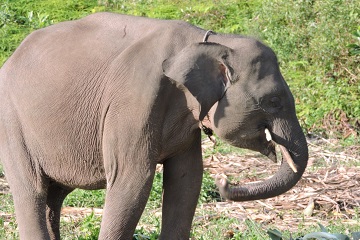
Tesso Nilo National Park (TNTN) is a forest area in Riau which becomes the habitat of Sumatran Elephant. Elimination of elephant habitat due to human activities causes Human Conflict with Elephant (KMG). Efforts made to resolve the conflict is by setting up Flying Squad through cooperation between the managers of TNTN and World Wide Fund for Nature (WWF). Flying squad utilizes trained elephant to lead wild elephants out of the forest into the park area.
To produce a trained elephant, it requires a training management which in accordance with the elephant's natural behavior, the level of intelligence of elephants according to age, sex and physical condition and does not cause adverse effects on elephants and trainers (mahout).
Burhanuddin Masyud, a researcher from Department of Conservation of Forest and Ecotourism, Bogor Agricultural University (IPB) explained that the management of elephant training consists of several aspects, which are elephant training curriculum, elephant training techniques/methods, and measurement/success rate in elephant training.
"The training provided influences the elephant's daily behavior. Elephant behavior is more obtained from learning process rather than instinct. Elephants are regarded as very intelligent animals that will be able to learn and understand the training materials quickly if the method applied is also appropriate. Elephants also have impressive memories, they are able to remember an object in a long time," he said.
Together with other researchers, Arum Ratnasari and Abdul Haris Mustari, he identifies the daily training and behavior of elephants at FS WWF TNTN. The team explained that the instructional list included in the training is covered in several stages. Starting from the adaptation stage, basic training (training to be ridden, following other elephants, training to be controlled), advanced training (taking stuff with trunks, long sitting training, and leg training for mahout’s up and down elephant’s body) and development (getting rid of tree obstacles with trunk, knocking down wood, fighting, and so on).
"The training curriculum contained in Flying squad WWF Riau has not become a standard training manual. There are 20 teaching materials given for each elephant with several stages: adaptation stage, basic training stage, advanced training stage and development stage. For the development stage functioned for two specifications of elephants: conflict mitigation elephant and riding elephant for ecotourism activities. Mahout (coach) combines verbal (speech), visual (code) and physical commands (pressing elephant’s body parts) in training techniques because elephants have good eyesight and sharp hearing, "he said.
Elephants are said as well-trained if they have been able to perform the commands given by the mahout without making a mistake. The average number of skills mastered by elephants tends to increase in accordance with the length of training. Mahout’s expertise and elephant’s physical condition is very influential on elephant’s ability to understand the given teaching materials.
"For the elephant's daily behavior, ingestive behavior (foraging activity) during the day shows the highest percentage compared to other behaviors. During the day elephants actively move to forage for food in the grazing areas. Ingestive behavior at night shows the highest percentage of behavior for female adults and calf, whereas in male adults the shelter seeking behavior shows the highest percentage. This happens because at night elephants use their time to rest and sleep. Elephants are not active in eating behavior caused by limited amount of feed and space," he said. (RYF)