IPB Students Created Plastics from Tempe Waste
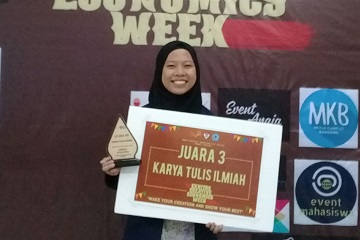
Students of Bogor Agricultural University (IPB), namely Rahmatusyifa and Muflihah Dini won third winner in the Creative Economics Week Equity. This competition was held by the School of Economics (STIE) Equity, Bandung, Thursday (22/3). Participants who were successfully selected to be the big three were IPB, Diponegoro University, and State University of Padang.
Innovation which was initiated by Rahma and Muflihah for the competition was the utilization of tempe waste for tempe packaging.
"Tempeh waste is a kind of waste generated in the process of soybean washing. This waste generated in the form of solid and liquid waste, and contains abundant protein that has great potential to be utilized as raw materials for packaging. The production of such packaging is easy, does not require complicated tools. The protein of the wastes then being crushed and mixed with additional ingredients to make the gel. The result is a plastic plate that is elastic and easily degraded in nature," explained Rahma.
Rahma stated that such innovation is the first of its kind, it has never been produced before. The produced package is very useful to replace plastic as packaging for food, especially tempeh. Plastic is a popular material for food packaging because it's easy to mold and print on, as well as cheap.
"The innovated plastic can to replace the usual tempeh wrap from banana leaves. This will minimize the damaged of tempeh, and it won’t be easily contaminated and durable. Not only tempeh, this innovated plastic can also be used to wrap other food products, "said Rahma.
Rahma herself hopes innovation can be useful to solve plastic waste problem in society especially for the world's marine habitats.
"Thousands of seabirds and sea turtles, seals and other marine mammals are killed each year after ingesting plastic or getting entangled in it. In addition, managing waste properly, especially plastic wastes, is expensive. We hope this innovation will be the solution and prevention of the amount of plastic waste in the community," said Rahma. Manufacturers of tempe will also beneficial as they get two advantages of tempeh products they produce.
Rahma stated that further study to improve her innovation has been needed. One of which is the processing time for such innovated plastic process, they should be shortened and should be inexpensive. So tempeh using such innovated packaging (made of tempe waste) will be affordable for the community at large. (Wied)