Professor Chair Holder of IPB: Manages Domestic Waste, Successfully Managing Domestic Waste Save 31 Billion Rupiah
If the city with one million population successfully managing their domestic waste properly, it can reduce the cost of waste transport of 31 billion rupiah per year. Without proper management, the deluge of solid waste causes severe pollution, helps diseases spread, and generates greenhouse gas emissions. It can also exacerbate urban flooding, which can endanger lives and compromise livelihoods particularly for the poor and marginalized. This is assuming the cost of transporting waste from the households to dumping sites (TPA) is 500 thousand rupiah per trip. Each household can also earn money from the compost produced by 20 thousand rupiah per month.
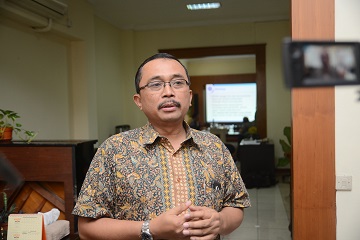
"Actually 75 percent of the waste can be reduced by managed in the place of origin or every home. The waste that needs to be transported to the landfill is only 25 percent, "said Prof.Dr.Ir. Arief Sabdo Yuwono, MSc, Professor Chair Holder of the Faculty of Agricultural Technology, of Bogor Agricultural University (IPB) in his pers conference prior his scientific oration, in IPB Campus, Baranangsiang, on 22 March 2018. As an environmental engineering expert, Prof. Arief explained some implementation of environmental engineering in Indonesia. In addition to waste management, Prof. Arief also explained the meaning of a healthy and comfortable environment.
Environmental health is expressed in the Environmental Health Index (IKL). The Environmental Performance Index (EPI) is a method of quantifying and numerically marking the environmental performance of a state's policies. This index was developed from the Pilot Environmental Performance Index, first published in 2002, and designed to supplement the environmental targets set forth in the United Nations Millennium Development Goals. There are three parameters for measuring IKL namely air quality, water quality and land cover.
"As reported by the Directorate General of Control, Pollution and Environmental Damage of KLHK 2015, 68 percent of river water quality in 33 provinces in Indonesia in the status of seriously contaminated by industrial discharges or domestic wastes. Pollutant sources are faeces, domestic waste water and household waste," he said.
Meanwhile, one way to present the air quality condition is by displaying it on the regular Air Pollution Index Board (ISPU) that is commonly installed in strategic position in urban areas. However, the existing ISPU has a 24 hour interval between sampling time and presentation time, there is a distinction between sampling interval and conversion time. Victims are exposed to dangerous air first, because the results of a new air quality analysis is shown the next day.
"We at the Department of Civil and Environmental Engineering IPB has managed to speed up sample analysis time into just one minute," he said.
Based on the Environmental Impact Analysis (AMDAL) studies and environmental damage he performed, Prof. Arief concluded that some people perceived the process of compiling the document and conducting the AMDAL studies are only a "formality" stage of the process of obtaining business licenses. Others see AMDAL as very important as an effort to maintain the quality of the environment.
"Currently AMDAL studies are conducted by incompetent officials. If it continues then the state of the world's environment will continue to decline," he explained.
On this occasion, Prof. Arief introduced his innovation in the form of industrial smoke density gauge named Opacity Meter and Dustfall Canister or dust gauge fell. The price is much cheaper compare to the similar device which costs 5.9 million rupiah. This is one-third of the price of the import one. "Patent application for both tools have been filed," he added. (Wied)