IPB Rector Presents Public Lecture in Al Azhar University of Indonesia
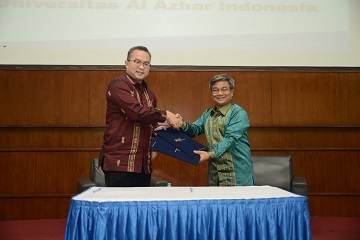
Bogor Agricultural University (IPB) and Al Azhar University Indonesia (UAI) have signed a formal agreement to work together on education, research and community service. The Memorandum of Understanding (MoU) was signed by the Rector of IPB, Dr. Arif Satria, SP, M.Si and UAI Rector, Prof. Dr. Ir. Ir. Asep Saefuddin, M.Sc, on Wednesday, 14 March 2018, at Auditorium Arifin Panigoro, Al Azhar University Campus Indonesia, Jakarta.
Rector of UAI, Prof. Dr. Ir.Asep Saefuddin, M.Sc convey, Signing this agreement with colleagues at Bogor Agricultural University marks the start of an exciting new era of close collaboration between our two universities in research and teaching. We believe that working together will lead to high-quality research that has an impact around the world. Collaborating on joint teaching programmes will further enable us to improve education for students in both universities. UAI also plans to set up a new study program (Prodi), Prodi Nutrition.
"The hope IPB can support the establishment of Nutrition Program so that it can become National Center for Urban Nutrition, regional and international, and improve the quality and quantity of human resources in the development of science and technology (science and technology) in the field of nutrition," Prof. Asep said.
Rector of IPB, Dr. Arif Satria stated that IPB will support the realization of the establishment of new study program at Al Azhar University of Indonesia. " We wish that the collaboration between our two universities will focus on the grand challenges, enabling us to build an national and interdisciplinary platform of research on sustainability. UAI will be able to produce a bachelor of nutrition that is able develop the ability to draw on and apply a range of skills and knowledge o apply knowledge, skills and follow the development of science and technology in the field of nutrition and health," said Rector of IPB.
After the signing ceremony Dr. Arif Satria was invited as the Keynote Speaker or Public Lecture in front of students and Al Azhar University of Indonesia (UAI) communities with the theme "Higher Education Facing Disruption Civilization".
Dr. Arif added that universities in the future must prepare for the era of disruption. In the age of disruption, policy organizations, governments and societies will need new frameworks to think and act, in order to be ready for a future challenges. This the era in which many 'disturbances' of civilization caused more frequent changes. "One of the driving forces for these changes is the advancements in technology, demography, the environment, and geopolitics that are also changing our higher education landscape. Of course the changes that occur must be addressed wisely for universities able to respond to the challenges of the times, "said Dr. Arif.
Dr. Arif then appealed to be prepared to adjust to the demands of the times and conditions of students. "Students today are millennials. His trademark since the early days familiar with the device, active in social media, as well as emphasizing the element of speed. Now, the number of jobs mostly involving routine skills,both physical and cognitive is shrinking over time. Increasing automation at factories is rapidly replacing workers at factories, even in low-wage countries like China. Artificial intelligence technologies like machine learning and computer vision are permanently eliminating high-skill jobs in offices, too. Therefore, lecturers and educational staff should have empathy, willing to listen and understand the needs of today's students. For example, lectures delivered with interactive media to make it more interesting, "he added.
Colleges must be prepared for an era of disruption. In addition to continuing to prepare a curriculum that meets the demands of the times, various facilities are also prepared. Especially in the era of industrial revolution 4.0 has evolved in the early 20th century which is characterized by the development of artificial intelligence, robot development, internet of things (IoT) and biotechnology so it must really watch and be well observed. Universities might highlight intangible values of in-person learning, like personal contact and nonverbal communication, but the costs are becoming a larger factor.
Dr. Arif expected that this cooperation between IPB and UAI can improve the synergy between various elements to promote Indonesia through improving the quality of education, research and community service for the better development of the nation. Most importantly, both our universities are research-intensive, adopting high standards of excellence and using this research to inform and enrich the student experience. (Wied)