
IPB Experts Control Brown Planthopper Raids with Simultaneous Planting Patterns
Planthopper pests that occurred several months ago need to be reviewed again. The planthopper pests that occurred in Indonesia is not only happened once, but repeatedly with almost the same causes. The explosion of this pest has been occurring since the New Order era and again occurred in 2011. By the end of 2017, planthopper pests again become a big problem and cause crop failure in various regions.
In an effort to tackle the same problem, the Department of Plant Protection, Faculty of Agriculture, Bogor Agricultural University (IPB) held a national seminar "Reinventing our IPM: Breaking the Vicious Circle of Brown Planthopper and Rice Virus Explosion." The seminar was held at Auditorium of Thoyib Hadi Widjaya Faculty of Agriculture IPB (22/3) attended by approximately 300 participants. Participants come from various backgrounds among others academics, research institutes, farmer groups, agricultural observers, and government agencies.
This seminar was a collaboration between IPB Plant Protection Department with Entomology Association of Indonesia and Association of Indonesian Phytopathology. The goal is to answer the latest problems on the planthopper pests explosion happens in Indonesia.
"We hope this seminar can provide a way out in solving the problems that arise due to the attack of brown planthopper. Hopefully this seminar can provide benefits for all of us," said Chairman of the committee, Dr. Ir. Ir. Giyanto, M.Si.
Head of Institute for Research and Community Service (LPPM) IPB, Dr. Ir. Aji Hermawan, M.M said this step is part of an effort to respond to last year's sudden planthopper pests attack that need a quick response to overcome the problem.
"Hopefully this national seminar can find the recommendation of planthopper pest control according to the concept of IPM (integrated pest control)," said Drs. Ir. Aji Hermawan.
The first brown planthopper explosion occurred around the 1980s. The government then issued Presidential Instruction No. 3 of 1986 on Improving Control of Brown Planthopper Pest on Rice. Presidential Instruction became the forerunner of the concept of integrated pest control (IPM).
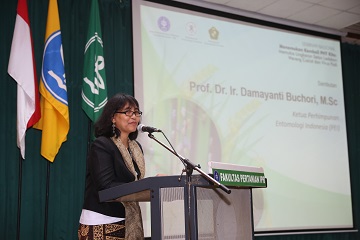
Prof. Dr. Ir. Damayanti Buchori, M.Sc. as Chairman of Entomology Association of Indonesia confirmed that the concept of IPM has been regulated in Law No. 12 of 1992 article 20 section 1 on the Protection of Plants conducted with the concept of IPM. She also emphasized that the concept of IPM should be implemented by the government and society, especially farmers. In addition to Law No. 12 of 1992, there is Law No. 6 of 1995 which is more emphasizing on the efforts of crop protection. If the law is improperly implemented or violated, the offending person should be criminally charged.
Meanwhile, according to IPB researchers. Ir. Hermanu Triwidodo, M.Sc, the status of planthopper pest attack in 2018 can not be predicted. The explosion of planthopper pests occur due to various factors. Among them are cropping pattern, pesticide use, rice varieties planted, and farmer behavior during rice planting. Research done a few years ago mentioned that excessive use of pesticides more triggered brown plant hopper attack.
"The unsimultanously cropping pattern also triggered the occurrence of brown planthopper pest explosion due to the availability of food sources for the planthopper pests.In addition to direct losses, brown planthopper pests also spread the Rice Ragged Stunt Virus (RRSV) and Rice Grassy Stunt Virus (RGSV)," he said.
Planthopper pest followed by virus attack can result in 100% harvest failure. This is because the RRSV and RGSV can attack the rice plants since still in the nursery. If the plant has been infected since the vegetative period, the plant can not flower and bear fruit. Symptoms caused by these two viruses are very distinctive.
Symptoms of grassy stunt among others dwarf plants, many tillers, and similar to grass, while the ragged stunt symptom are dwarf plants with yellow colour. This symptom is similar to the nutrient deficiency symptoms so farmers decide to increase the dosage of the fertilizer. Whereas by increasing the dose of fertilizer or pesticides can kill some predators and natural enemies of planthopper pests that trigger its explosion.
Control efforts recommendation from this seminar in accordance with the IPM concept are by conducting simultaneously plant crops, managing the soil well, using varieties resistant aphis (Inpari 18, Inpari 13, Inpari 33), making a nursery in a clean land from pest sources, installing light trap around the land, conducting environmental engineering by planting flower-growing crops to provide a food source for natural enemies, applying entomopathogenic fungi (Metharizium anosiplae) and using appropriate and precise dose type of insecticides.
"The use of resistant varieties that are not suitable with the location or soil may not necessarily minimize the occurrence of brown planthopper explosion. Potential control efforts are done by considering the pattern of planting and providing food sources for predators and natural enemies of plant hopper, "said Head of Tungro Disease Research Center, Sidrap Regency, South Sulawesi, Dr. Fausiah T Ladja, SP, M.Si. (TK)

