Strategies Set by IPB’ Experts to Reduce Ocean Plastic Pollution
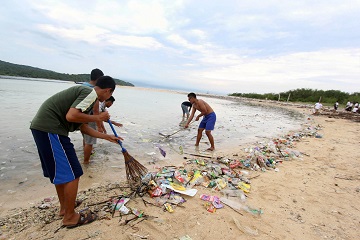
The western coast of Selayar Island gets the impact of solid marine debris every west season (December-March). Marine debris is defined as “any persistent solid material that is manufactured or processed and directly or indirectly, intentionally or unintentionally, disposed of or abandoned into the marine environment or the Great Lakes.” Almost all the marine debris has come from offshore. Marine debris is litter that ends up in oceans, seas, and other large bodies of water. In the absence of management, part of the marine waste is carried back to the sea during the east season and has an impact on other islands. Marine waste deposited on the west coast has social, economic and ecological impacts. One question we have probably been asking ourselves is why the debris accumulates in the western coast of Selayar Island.
To respond such question, a group of researchers of the Department of Aquatic Resources Management, of the Faculty of Fisheries and Marine Sciences of Bogor Agricultural University (FPIK IPB), namely Roni Hermawan, Ario Damar and Sigid Hariyadi, carried out the research program to analyse the type and weight of coastal marine debris on west of Selayar Island, South Sulawesi.
The research included the type, weight, density and distribution of marine waste; impacts in the economic, social and ecosystem environments; and develop appropriate marine waste management strategies.
The numbers are staggering: There are 4.978.3 g / m2 of plastic debris in the ocean. Of that mass, thousands tons float on the surface, while some 7.7 items / m2 plastic microfibers per square meter litter the deep sea. The density of inorganic density is 14.3 items / m2 for the number of pieces and 564.8 g / m2 for the waste. Increase in waste by 354,6 g / m / day and 2,8 item / m / day.
Although scientists have known for decades about the accumulating mass of ocean debris and its deadly consequences for seabirds, fish, and marine animals, the science of sea trash is young and full of as-yet unsolved mysteries. The impact of marine debris on seagrass and biota can alter and cause physical damage to the habitat. Some of the marine debris deposited on the beach is plastered by several coral species that can affect biodiversity. The impact of the mangrove ecosystem is the suppression of mangrove seeds with the waste material, the mangrove seeds are blocked by garbage and fail to germinate. While social impacts such as aesthetics and reduced tourists.
The highest waste management by the community is the use of waste as daily fuel, only a small percentage or 8-28 percent of garbage are further utilized for higher economic value and waste function. They should recycle paper, plastics, glass, and metals for a variety of new uses. "Assuming no waste management infrastructure improvements, the cumulative quantity of plastic waste available to enter the marine environment from land is predicted to increase by an order of magnitude by 2025," he predicted.
Waste Management and Pollution Control is a priority for the Indonesian government to help protect and conserve the natural environment for its today and tomorrow’s generation’s safety and success. To win the battle against plastic pollution, the Indonesian central and regional governments need to strengthen their legal framework. The marine waste management strategy can be implemented with 3R + P approach (recycle, reuse, recovery energy and participant). The capacity of coastal areas and the open ocean to receive waste can be of great convenience and economic value, if properly managed. Plastics waste recycling companies generate profits of Rp 16,379,472 per month from the production of 48 tons of plastic waste of plastic recycling. Recycling companies of the communities will earn Rp 10,904,472 per 30 tons of recycling wood into charcoal briquettes. Waste management can be done by raising the community’s awareness level of waste. To achieve this, a carefully thought-out waste education and awareness strategy must be developed in order to change community habits and behaviour and traditions. (Wied)