
IPB Student Created A Cheap Burn Treatment Derived from Shrimp Waste
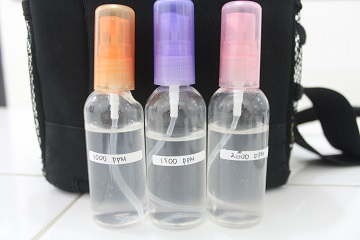
Antonius Sugiyanto, the student of the Department of Aquatic Product Technology, of the Faculty of Fisheries and Marine Sciences of Bogor Agricultural University (FPIK IPB) successfully created the latest innovation by utilizing shrimp shell wastes. Anto, his friends familiarly called him, utilized chitosan, as a cationic natural polymer, used as a topical dressing in wound management owing to its hemostatic, stimulation of healing, antimicrobial, nontoxic, biocompatible and biodegradable properties.
The title of his research is "Penaeus Nanochitosan sebagai Biomaterial Medis untuk Penyembuhan Luka Bakar pada Tikus Sprague Dawley secara In Vivo (Penaeus Nanochitosan as Medical Biomaterial for Healing Burns on Sprague Dawley Rats In Vivo". This study was conducted under the supervision of Dr. Pipih Suptijah and Waras Nurcholis, S.Si, M.Si.
"Shrimp processing industry produces a lot of waste. A large amount of waste produced on shrimp processing industries is rich in nutraceuticals such as carotenoid (astaxanthin) and chitin. This waste can be converted into chitosan that can be used as wound healing agent, "he said.
Burns are one of the most common household injuries, especially among children. The term “burn” means more than the burning sensation associated with this injury. Burns are characterized by severe skin damage that causes the affected skin cells to die. Burns are damage to the skin or tissue loss caused by contact with heat sources, such as fire, hot water, chemicals, electricity, and radiation. Burn patients are also at risk for developing sepsis secondary to pneumonia, catheter-related infections, and suppurative thrombophlebitis.
According to Anto, chitosan as a cationic natural polymer, has been widely used as a topical dressing in wound management owing to its hemostatic, stimulation of healing, antimicrobial, nontoxic, biocompatible and biodegradable properties.
In his research, Anto modified chitosan into nanokitosan. Nanocitosan has a smaller particle size that is reactive and can accelerate wound healing. Nanokitosan in this study was tested in vivo to Sprague Dawley mice.
Macroscopic and microscopic observations showed that the formulation of nanochitosan used at 1000, 1500, and 2000 ppm had an effect on the recovery time and burn wound healing percentage on the 18th day of 99.6%; 98.7%; and 93.8%. Wound conditions and wound closure percentage were better than positive controls and negative controls. Nanochitosan preparations have entered the early maturation stage on the 7th day. Maturation is the last stage in the wound healing phase.
Anto expected that his research will provide an alternative choice as a material of medical biomaterials on safe, practical, and enriching burns of information for the pharmaceutical world about the benefits of nanocitosan. The purpose of his research study was to analyze the benefits of nanocitosan to the pharmaceutical industry and healthcare system. "I hope such research will reduce the waste of fishery processing and turn it into a value-added innovation product, namely chitosan from shrimp shells", he concluded. (Wied)

