
IPB Researchers Recommended Four Techniques for the Cultivation Palm Oil Planting in Unproductive Lands
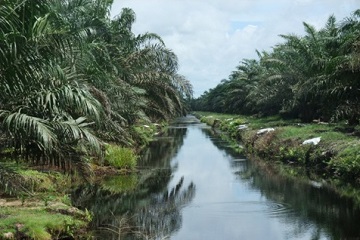
Researchers from the Department of Soil Science and Land Resources, of the Faculty of Agriculture, of Bogor Agricultural University (FAPERTA IPB), Dr. Ir. Suwardi, M.Agr explained that soils with suboptimal availability of nitrogen, phosphorus, and potassium soils such as peat and acid sulphate soils in Indonesia are still available for oil palm planting. These lands are actually difficult to cultivate with other agricultural crops, but there are plants that can grow well namely oil palm and acacia. A proper evaluation of the suitability of peats for a particular crop under fixed conditions first requires judgement on which characteristics of the peat and the peatswamps should be taken into account. The nature and range of any limitations for a certain use can then be assessed. Because of the dramatic changes that take place with peat wastage it is sensible to evaluate the potential use of the mineral soil beneath the organic materials taking into account the predicted environmental conditions after wastage. Land use has also been studied previously and able to sustain the growth of palm oil so that it becomes productive land with special techniques.
"There are five techniques that can be done to fix the peat soil and acid sulphate soil, to be planted with palm. The best amendment for soil of any texture is organic matter, the decaying remains of plants and animals. As it decomposes, organic matter releases nutrients that are absorbed by soil-dwelling microorganisms and bacteria. For peat soil, land improvement is done physically, water management, fertilization, and selection of varieties. For acid sulphate soil can use fertilization and the addition of organic materials or extracts of organic material that humic acid, "said Dr. Suwardi in Bogor.
Further, Dr. Suwardi explained that the condition of peat soil and acid sulphate soil in Indonesia is still much to be productive by planting oil palm. Because oil palm is able to contribute to the source of state income through the export of crude palm oil (CPO). Although oil palm cultivation is a strong driver of economic development in Indonesia, providing jobs and incomes to millions of people, it is strongly denigrated for its environmental impacts. "Indonesia is able to produce four tons of CPO per hectare per year. CPO and kernel oil prices have been rising, encouraging investors to develop plantations on the large areas of suitable land in the islands of Sumatra, Indonesia. This figure far exceeds the production of vegetable oils other commodities such as soybeans or rapeseed, "he said.
The increasing international demand for biofuel and the current lack of available land on mineral soils has accelerated the conversion of peatlands to oil palm plantations especially in Indonesia, where nearly 25% of all oil palm plantations are located on peatlands. To support palm oil production in Indonesia, several technique were presented. For the peat soil category the physical soil is compacted using heavy equipment. This is done to prepare relatively soft peat soils to become solid and strong to support the palm oil. However, oil palms cannot survive in undrained waterlogged peatlands. Drainage for oil palm growth in peatlands is installed between 40 and 80cm depth, but the water table could recede below 80cm during an extended drought. The second technique is still on peat soil i.e. by arrangement of water, manufacture and management of plantation ditch. Water height should not cause flooding or water shortage by maintaining water level between 60-80 cm since peat soil is difficult to hold water. As peat soil is nutrient-poor, therefore accurate fertilizer recommendations are important, because problems can result from either inadequate or excessive fertilization. Too little fertilizer leads to poor plant growth, but too much fertilizer can also reduce plant growth and quality. In addition, excessive applications of fertilizer can be harmful to the environment. Finally the technique uses shorter stems varieties so that peat soils are able to support the stand of the palm oils.
The oil palm is cultivated predominantly on tropical soils in the orders Ultisol, Oxisol, and Inceptisol. These soils are highly acidic with low buffering capacities as a consequence of cation leaching. Fertilizer is used to anticipate the nature of acid soil is poor nutrients and difficult to hold nutrients. Low-release fertilizer will reduce the washing of nutrient content by rain water. However, oil palm is adapted to acidic conditions, and with appropriate management, oil palm plantations can also be productive on “problem soils” such as acid sulfate soils, deep peat and acidic high aluminum soils, where few other crops are successful.
However, these innovations have not been widely applied by palm oil business actors planting in peat soils and acid sulphate soils. "The techniques has been applied only by large oil palm plantation companies. Oil palm farmers have not utilized this technique as it required large capital. Currently the palm oil production grown by farmers in peat and sulphate soil are still low. One alternative for farmers, they should become a plasma farmer of large companies. Plasma smallholders, smallholders who have an exclusive supply agreement with a mill, receive technical assistance and can access agricultural inputs such as seed stocks and fertilisers thanks to their partnership scheme with the mill. Plasma smallholders are more likely to be able to meet RSPO sustainability standards than independent smallholders," he said.
Smallholder farmers are important players in the palm oil sector, yet they are largely overlooked by sustainability initiatives and discussions about deforestation and palm oil production. Through this technique is expected to be a way to preserve the nature and utilize part of unproductive land in Indonesia to support energy independence. "CPO can be a source of renewable energy, it can be converted into Biodiesel. It has positive performance attributes such as increased cetane, high fuel lubricity, and high oxygen," he concluded. (Wied)

