
IPB Researchers Improve Ornamental Coral Reefs Through Floating Nursery Method
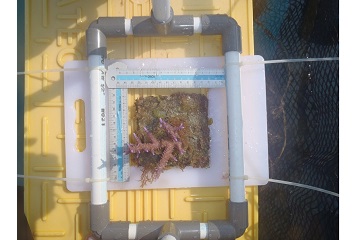
A group of researchers consisting of students and lecturers from the Department of Marine Science and Technology, Faculty of Fisheries and Marine Sciences (FPIK) of Bogor Agricultural University (IPB), namely Muhammad Khoyrul Prasetyo, Beginer Subhan and Neviaty Putri Zamani conducted a research aimed at improving the quality of coral reefs through transplant activity.
The increase of human activities capturing marine biota in coral reef ecosystems with destructive fishing gear and collecting the coral reefs excessively can result in coral reef damage. This serious problem needs to be stopped and solved. This fact made Khoyrul and the team doing a research on coral reef transplantation as a solution.
Coral transplantation is a fragmentation technique of coral colony propagation by utilizing asexual reproduction. Many benefits derived from this transplantation technique, one of which is for business purposes such as ornamental corals. Corals can be used as a decoration in an aquarium because of its attractive shape.
Some research on coral transplantation have been done in Indonesia. Various methods used in transplant activities include net and coral fragment method, net shelf and artificial substrate method, natural substrate method and concrete method.
Floating Nursery is a transplantation method by placing transplanted corals floating or not touching the bottom of the waters.
This research aimed to measure the absolute growth and survival percentage of Acropora formosa coral species. This research was conducted for three months in the area of Keramba Nusa Resto in Gosong Pramuka, Pramuka Isle, Seribu Island, DKI Jakarta.
Floating Nursery is designed in the form of two shelves transplantation. Both shelves are placed at different depths from the sea level. The 1st shelf is placed at a depth of 2 meters, while the 2nd one is at 4 meters deep. Each shelf is filled with 24 pieces of coral fragments that have been attached to an artificial substrate placed on a net stretched over a 1 m x 1 m of the shelf.
The treatment used in this research was the cleanliness of the coral fragments and their substrates. Some fragments and substrates were cleansed from the dirt, algae and associated biota, while others were not. Another treatment was the difference of the depth where the transplanted shelves were placed.
The results showed that there was no difference in the absolute growth rate of the average length and width based on the cleaning treatment, but there was a difference of absolute average growth rate of high.
In addition, the absolute growth, length, width and height of coral fragments showed a marked difference based on the shelf positions. This meant that the application of floating nursery methods on Acropora formosa corals could produce a high percentage of survival up to 100 percent. (TK)

