
Collaborative Research between IPB and Belgium on Tilapia Larvae
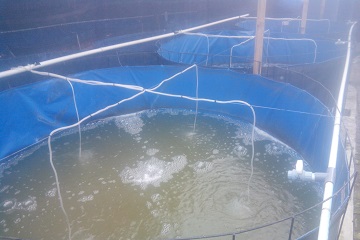
The research team consisted of Julie Ekasari, Dio Rheza Rivandi, AmaliaPutri Firdausi, Enang Harris Surawidjaja and Muhammad Zairin Jr from the Department of Aquaculture, Faculty of Fisheries and Marine Sciences, Bogor Agricultural University (FPIK IPB) with Peter Bossier and Peter De Schryver from Laboratory of Aquaculture and Artemia Reference Center, Ghent University, Belgium conducted a study to see the effect of biofloc technology (BFT) on the growth and resistance of tilapia larvae (Oreochromis niloticus).
"The basic principle of the technology is the nitrogen cycle management in stagnant water aquaculture system with the stimulation of microbial growth capable of converting nitrogen waste, so that it can be used as a feed source by aquaculture species," Julie said.
The larva obtained was transferred to a plastic tank with a volume of 1.5 liters water, then 15 larvae were stocked and growth with four treatments including BFT / BFT: fish larvae from BFT tank was transferred to BFT water (with molasses), BFT / C: fish larvae from the BFT tank was transferred to the control water (without molasses), C / BFT: fish larvae from the control tank was transferred to BFT water (with molasses) and C / C: Fish larvae from the control tank was transferred to control water (without molasses). Growth and survival were seen after 14 days of maintenance.
From the experiments, the team found that the larvae survival from BFT was 90-98 percent. It was higher than larvae survival of control water media without the addition of molasses i.e. 67-75 percent. While the larval growth was less affected, however, the larval growth appeared similar when placed on the BFT water medium.
The researchers also tested the larvae against pathogenic bacterial infection of Streptococcus agalactiae, and it was seen that the larval survival of the BFT media was significantly different. Larvae survival of the BFT water medium was 75-80%, higher than that of the control water medium i.e. about 55%.
The placement of larvae from control water to BFT water media was able to increase the resistance to infection by about 70% survival. In the salinity stress test, 1 hour observation was performed to determine the larval tolerance to osmotic pressure at 35 g/L. As a result, larvae derived from BFT showed survival of 72% and 42% at 1 hour and 24 hours after salinity pressure, respectively. This was significantly higher than that of larvae derived from control media with survival 33% and 5%, respectively. "Overall, data indicated that the application of biofloc technology for parent maintenance and larval production may increase larval production and quality," she said. (TK)

