IPB Student Utilized the Sea urchin (Diadema setosum) for Elderly Bone Problems Solution
The health problem that needs to be noticed in the Elderly is osteoporosis. Osteoporosis, or thinning bones, can result in painful fractures. Risk factors for osteoporosis include aging, being female, low body weight, low sex hormones or menopause, smoking, and some medications. Osteoporosis occurs due to decreased absorption of calcium in the body. To overcome this, milk is a great choice. Many people think that osteoporosis is a natural and unavoidable part of aging. However, medical experts now believe that osteoporosis is largely preventable. But commonly consumed cow's milk has high levels of fat that can trigger a stroke. Another alternative is to consume low-fat soy milk. But soy milk has a small calcium content and can not meet the needs of calcium elderly.
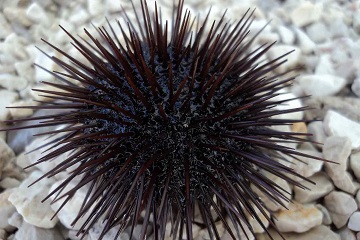
Meanwhile, the sea urchin (Diadema setosum) is one of the fishery products that has become an important commodity in various countries. Part of sea urchin that is important for human health is the gonads. The extracts of the gonad of Diadema setosum were found to have steroid, amino acids and antioxidant compounds. Overall, nutrient contents and active compounds in the gonad of Diadema setosum are essential components needed for immune system.Therefore besides its potency as alternative food source, gonad of Diadema setosum has potency to become the source of immune-nutrient. The waste of sea urchin shells with more than 90% rendemen has not been utilized. Shells of sea urchins have a high mineral content that could potentially be a source of natural calcium.
This is the reason why Syahira Addina, a student of the Department of Aquatic Product Technology, for the Faculty of Fisheries and Marine Science (FPIK IPB) implemented the research program on the production of calcium from the shells of sea urchins. Syahira produced calcium from sea urchin in nanoparticle sizes and analyzes the speed of its fortified absorption in soy milk in Sprague Dawley rats. His research was on “Karakteristik Nanokalsium Cangkang Bulu Babi (Diadema setosum) dan Efektivitas Penyerapannya Secara In Vivo = the Characteristic of Nanocalcium of sea urchin (Diadema setosum) and its Effectiveness for In Vivo Absorption. This research was carried out under the supervision of Dr. Dra Pipih Suptijah, MBA and Prof. Dr. Ir Dewi Apri Astuti, MS.
"Soy milk (also spelled soymilk) is a plant-based drink produced by soaking dried soybeans, grinding them in water, boiling the mixture, and filtering out the residues. Soy milk is a type of imitation milk because the raw material comes from vegetable materials. This soy milk has a very good nutritional content because it is close to the nutritional content in cow's milk. However, the calcium content is still relatively low. In 1 cup of soy milk there is only 61 mg of calcium while in cow's milk reaches 285 mg. So it takes fortification of nanocalsium in soy milk to meet the needs of calcium elderly ", said Syahira.
Syahira used Sprague Dawley rats to analyze the speed of nanocalcium absorption. The results showed that the yield of nanocalcium obtained was (2.81 ± 0.20)% with ash content of nanocalcium (80.14 ± 0.62)%.
"The high mineral contents of ash has indicated that the demineralization process can dissolve most of the minerals in the shells of sea urchin, so that the content of inorganic materials in nanocalcium becomes high. Macro (Ca, Na, K and Mg) and micro (Cu, Fe, Mn and Zn) mineral composition of urchins was specified by Nanocalcium. The research revealed that adult purple sea urchins have the ability to precipitate skeleton composed of a range of biominerals spanning low- to high-Mg calcites. The biggest mineral content in sea urchin is calcium and magnesium, "he said.
The size of the fortified nanocalcium into soy milk is (9,66 ± 2,288) nm. Fortification is done as much as 5% into soy milk. The results show that the absorption of calcium in the nano size faster than calcium in the micro form. Nanocalcium can be absorbed into the blood by 5.91% every minute while the microcialcium can only be absorbed 1.30% every minute.
"The research revealed that more nanocalcium was absorbed in the blood compared to the method with microcalcium at the same time," he said.
Nano-sized calcium can be absorbed rapidly and completely into the body. The absorption of calcium will increase as the absorption time increases.
Syahira hopes further research on the manufacturing of nanocalcium from the shell of sea urchin (Diadema setosum) will be carried out to improve the wealth of references on the demineralization process of sea urchins. "I hope the results of this study will be an alternative method to help overcome the problem of calcium deficiency in the elderly due to decreased calcium absorption, also provide information about the speed of nanocalcium absorption of sea urchin ", she concluded. (Wied)