
IPB Experts Utilizing Parasitoid Insects to Control the Cucumber Pests
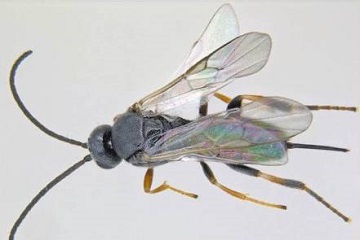
Pests and diseases often attack cultivated plants. One of which is Diaphania indica, the cucumber moth or cotton caterpillar, is a widespread but mainly Old World moth species. It belongs to the grass moth family, and therein to the large subfamily Spilomelinae. The pest feeding on the leaves, flowers or cucumber fruit of members of the cucumber family. This reduces the amount of fruit produced, decreases the quality of the fruit and affects the decrease in yields. One of the control methods to eradicate Diaphania indica is using natural enemies or commonly referred to as parasitoids, Apanteles taragamae Viereck.
Apanteles taragamae Viereck is a gregarious parasitoid (parasitoids that live in groups in one host) capable of causing damage to various cucurbitaceous plants. A. taragamae is a common braconid parasitoid associated with various lepidopterous crop pests. Research on parasitoid A. taragamae is still very limited and mostly are on the biology, behavior and exploration of natural enemies. Whereas biological control by using natural enemies requires an understanding of the population dynamics, the movement from natural habitat to cultivation and migration.
Realizing the importance of the biological control agent, researchers from the Department of Plant Protection, of the Faculty of Agriculture of Bogor Agricultural University (FAPERTA IPB), namely Prof. Damayanti Buchori, Dr. Evawaty S. Ulina, Dr. Pudjianto and Prof. Sjafrida Manuwoto carried out the research program on parasitoid insects used as promising candidate for the biological control for pests of the cucumber plants.
The study aims to study the pattern of A. taragamae dispersal in agricultural landscapes. The research was conducted in cucumber plantations in four landscape of Bogor Regency. The four agricultural landscapes are in the village of Bantarjaya, Mekarjaya, Cihideung and Cibanteng. Imago or adult insect A. taragamae used in this study were obtained from the parasitic D. indica larvae in the field. The parasitoid was labeled using the 32P molten isotope which are applied via the parasitoid imago feed.
A total of 750 imago parasitoids (about 500 females) were utilized for the study, and they were released in every landscape. Then, after 48 hours of released they were recaptured via host collection (D. indica) by direct capturing method. The results of host collections in each field vary from 1,200 to 8,500 individuals. The ability of parasitoids in parasitizing or killing of the highest pests is found in Bantarjaya (32.82 percent) while the lowest in Mekarjaya (25.10 percent). Based on the analysis of the pattern both A. taragamae and its host showed a group pattern.
This has indicated that parasitoid dispersal follows the presence of its host. The researchers also measured the volatiles of the parasitoid Apanteles taragamae. The research revealed that Parasitoids were able to disperse till the furthest point in the plot 53.6 meters. Dispersal patterns (spreading) and the ability to disperse of parasitoids tend to be influenced by the presence of host and not the habitat condition around the land. (Wied)

