
Researchers of IPB Monitored and Analyzed Water Quality of Ciliwung River Basin as Source of Jakarta Bay Pollution
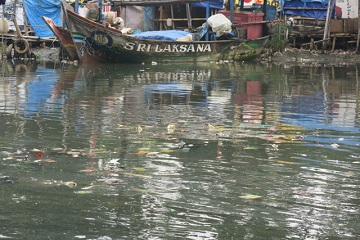
Jakarta Bay (Indonesian: Teluk Jakarta) is a bay north of North Jakarta city. 13 rivers flow into the bay. The majority of the bay's coastal communities consist of people living below the poverty line, in conditions of poor sanitation. The bay routinely receives organic liquid waste from at least ten million people of those communities. Nutrient inputs from agricultural runoff, industrial pollution, and wastewater have led to eutrophication, which in turn led to changes in the area's biodiversity, Most of people argued negatively about Ciliwung, it is seen as a giant dumping ground, slump area, water pollution, breeding place of disease, flood caused.
Two Researchers from the Department of Water Resources Management, Faculty of Fisheries and Marine Sciences, Bogor Agricultural University (FPIK IPB), namely Dr. Ario Damar and Dr. Yonvitner carried out the research program on the coastal pollution in Jakarta Bay through monitoring and studies on water quality of Ciliwung River Basin. .
This study aims to determine the volume of organic material external loads in the form of dissolved inorganic nutrient concentrations (nitrogen, phosphate and silicate) discharge by the rivers into the Bay of Jakarta.
The researchers revealed that Sunter River, Muara Karang and West Kali Baru contain relatively high amounts of ammonia. Meanwhile, the nitrate content is quite high in Pesanggrahan and Ciliwung River. Phosphate also has a high value in Muara Karang, Sunter, Cakung and Kali Baru Barat. Whereas silicate content is relatively uniform across the river when compared with nitrogen and phosphate.
"The rivers passing through Jakarta's densely populated city contain high nitrogen and phosphate values. However, people in the slump area become the primary contributor for the Ciliwung’s problem. People use the water for bathing, drinking, and wasting their waste into the river. While rivers that pass through the suburbs like Bekasi and then discharge into Citarum river contain relatively high nitrogen, while its phosphate is lower concentration as the rivers are not the source of compound. Analysis of the sources of water pollution indicates that 64% of biological oxygen demand in the Citarum River is produced by domestic and municipal activities, compared with 36% from industrial or agricultural activities combined. Phosphate comes more from the domestic population. High ammonia content found in Sunter, Muarakarang, West New Kali then Pesanggrahan and Ciliwung. High phosphate content is also found in Muara Reef, Sunter, Cakung New West times and low soluble oxygen below 3 milligrams per liter, meaning that too much domestic waste discharges into the river, "he said.
The research revealed that the dissolved oxygen content in all the rivers observed had a low value of 30 percent between 3-6 milligrams per liter and 70 percent below 3 milligrams per liter. The N load is 21,895 tonnes of Nitroger per year, phosphate of 3,405 tonnes per year and 10,433 tonnes of Silicon per year.
Nitrogen (N) and phosphorus (P) are essential nutrients for all living organisms. Soil, fertilizer, and manure are all sources of N and P to growing crops. Atmospheric deposition (the air we breathe is mostly N gas) and irrigation water are also N sources. If not managed efficiently, much of the N and P applied to and present in agricultural systems can be lost to the environment. If N and/or P are present in aquatic systems (streams, ponds, estuaries, etc.) above critical levels, negative environmental impacts will occur. Nitrogen and phosphorus are also essential elements in the aquatic environment. However, agricultural and urban land practices add more N and P to surface waters than they would receive under natural conditions. When one or both of these nutrients exceed critical concentrations, pollution of downstream water bodies can occur, it cause eutrophication the impacts the local ecology by blocking sunlight from reaching beneficial submerged aquatic vegetation. "Organic materials discharging into river must be decomposed by bacteria, in decomposition requires oxygen, if too much organic matter the process runs fast and oxygen demand is also fast so the rivers in Jakarta oxygen is depleted. As a result the smell is dirty and black due to a lot of organic material. Such wastewater which is composed of a variety of inorganic and organic substances, are from household waste, "said Dr. Ario.
In term on the eutrophication, the researcher explains that Jakarta Bay is grouped into three classes. The three classes are Hyper-eutrophic along the coastal area of Jakarta Bay, Eutrophic occurs in the area after hyper-eutrophic area and mesotrophic area located in the outermost part of Jakarta Bay. This research suggests that communal domestic sewage treatment shold be prioritized as an urgent need for pollution management in the Bay of Jakarta. "The city of Jakarta receives a high load of nitrogen and phosphate, so it should be reduced. Understanding the various forms of pollution and how it is created form the first steps in discovering the best way to stop the pollution of Jakarta Bay. We have to find the source of the Jakarta Bay pollution utilizing Ipal (Installation of wastewater treatment) before being dumped into the river. It recommended that Jakarta city should install communal Ipal for domestic sewerage, "he concluded. (Wied)

