
IPB is Ready to Recommends the Formulation of the National Rice Trade
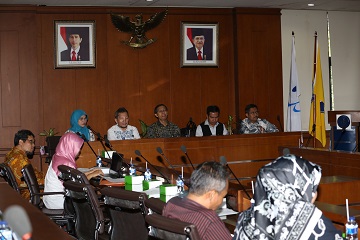
Responding to the many statements about rice policy which later developed into discourse, the Directorate of Agricultural Strategic and Policy Studies (KSKP) of Bogor Agricultural University (IPB) organized Focus Group Discussion (FGD). The theme for the present FGD is on "Quo Vadis Kebijakan Perberasan Nasional (Quo Vadis of National Policy for Rice", the venue of the special event was the Rector Meeting Room, IPB campus, Dramaga, on 31 July 2017.
The resource persona invited as speakers for the meeting were Prof.Dr. M. Firdaus, Professor Chair Holder of Faculty of Economics and Management of IPB (FEM IPB), Alamsyah Siragih of Ombusman of the Republic of Indonesia (ORI), Dr. Ir. Kasa, of the Ministry of Trade, and Ir. Jodi H. Iswanto, of the Healthy Agriculture Indonesia. In addition to explore the latest information on national rice issues, the results of this FGD will be formulated as a recommendation of rice policy and will be submitted to the government.
In his presentation, Dr. Kasan rectifying any policy related to the incident of PT. Indo Beras Unggul (IBU) some time ago. Currently the Ministry of Trade is in the process of rearranging rice policies especially on the Highest Retail Price (HET). Minister of Trade, Mr. Enggartiasto Lukita, formally revoked the Regulation of the Minister of Trade (Permendag) No. 47 / M-DAG / PER / 7/2017 on the pricing of the buyer's reference in the farmers and the reference price of sales in the consumer. Referring to the regulations, the price of medium and premium rice is set on Rp 9,000 / kg.
"At the time the food committee to take action, Permendag No. 47 / M-DAG / PER / 7/2017 has not been in force as it has not been enacted or not signed by Menkumham. So there is no rule of law in force. Most rice traders do not have a game plan when it comes to sell their commodities, please operate as usual, "he said.
The Ministry of Trade wishes to provide a solution to this incident. Today it is being reorganized from all aspects and involves all existing stakeholders.
"So the legality from the Ministry of Trade is clear, we do not have to fear. Because of this incident the supply of rice in the Cipinang Market had dropped to 1800 tons from the usual 3000 tons per day. Now it's back to normal, "he explained.
The present FGD has successfully formulated several points, and they will be submitted by Dr. Kasan to the discussion of the national rice trade system. In order to be valid, data must be both accurate and precise, the purpose of restructuring rice business should be clear (price stabilization or to improve the welfare of farmers), specification of rice classification must be clear (bulk, medium and premium), control of supply and self-sufficiency of rice by increasing the production and decreasing the consumption.
" Therefore it is important to consider the possibility of the adequacy of food (rice) for the middle to lower economic class. Our rice production is high but our consumption is also high, "he said.
Meanwhile, Alamsyah from ORI stated that the anti-import policy reduce trade and tend to distort economic activity, won’t be able to lift the fate of farmers. Therefore, ORI plays a important role in strengthening the government position.
Thanks to this incident, Ombusman succeeded in formulating seven malpractices in the national rice trade system. First, prognostic funds planned by the government contains conflict of interest. The accuracy of rice productivity data, often the data presented do not valid. They tend to lead to surplus, but the price remains high. Second, subsidized fertilizer sales. Government encouraged to develop a welfare-oriented agricultural system by optimizing the land and empowering the people, small farmers. In addition, the should also reorganize the selling systems of subsidized fertilizer. Third, the military presence may affect civil society’s role in agriculture because their involvement may discourage the genuine participation of farmers. Even though agriculture work can be classified under military operations other than war, the government should be able to explain the urgency of the military’s involvement in the food sector. Fourth unorganized industries. Not all rice milling companies are incorporated in the association (there is no accurate data) so it has the potential to eliminate the source of tax revenue. Fifth, most of Indonesia's stocks are of low quality long grain rice due to the purchase from farmers based on Government Purchase Price (HPP) without standardization. This threatens the quality of rice stock.
“Stock beras kita yang ada di Bulog kualitas dan kuantitasnya sangat memprihatinkan hanya 300-400 ribu ton. Beda dengan India yang stocknya bisa mencapai jutaan ton. Ini mempengaruhi wibawa sebuah negara,” ujarnya.
"Though the country had adequate stock of rice this year, with the State Logistic Agency (Bulog) holding some million tons of supply, sufficient to meet the demand for the next seven months, but we have to be careful with this. Differences with India whose stock can reach millions of tons. It affects the dignity of a country, "he said.
Sixth, Replace RASKIN with a targeted food voucher and cash transfer programme. Seventh, Indonesia has to ban the importation of agricultural products, including rice. Indonesian importers must comply with numerous and overlapping import licensing requirements that impede access to Indonesia’s market.
Rice Pricing Policy and PR forwards
According to Prof. Firdaus, government intervention in the rice industry is not only in the form of input subsidies (fertilizers, seeds) and the provision of infrastructure facilities; But also in the form of price policy i.e. government purchase price (HPP) and the highest retail price (HET). government purchase price This intervention is also very common in other rice-producing countries. Both pricing policies are primarily intended as a reference for Bulog as a national food buffer body to make purchases to farmers or operations in the consumer market. Despite various obstacles limiting the authority of Bulog to cause problems in the field.
"Some discussions have been carried out earlier on the effectiveness of grain HPP. An effective price ceiling will lower the price of a good, which decreases the producer surplus. The effective price ceiling will also decrease the price for consumers, but any benefit gained from that will be minimized by the decreased sales due to the drop in supply caused by the lower price. Thus, as the selling price of grain by farmers was always far above the HPP they cause the unstable of rice prices in the market. Over the past three years, prices have always been above Rp 4,000. The government is suggested to reduce the current HPPs, they should be lower than they should be. With regard to the research carried our recently, components such as land rent and all labour costs must be taken into account, "he said.
According to the Minister of Agriculture, Sutarto, the price of fertilizer based on the current subsidy system accounted for between 20 percent and 30 percent of rice farmers’ production costs, with the average farmer earning only Rp 6 million a hectare per year. The subsidized fertilizer scheme is Indonesia's biggest farm support program at 30.1 trillion rupiah, accounting for around half of this year's agriculture budget. Though the situation is field is very different. Some research revealed that only about 10 percent of farmers rice products were brought to milling (Gapoktan) then sell them as rice (beras), the rest were sold to the collectors. The Government of Indonesia has decided to increase the "Government Harga Pembelian Pemerintah (HPP)" Price policy of rice commodity will affect others performance of sectoral economics and so the societies’ welfare. If farmers have a good bargaining position to their harvested commodity, their income will increase as much as rice price increase and vice versa.
According to HET set by the government, the ceiling price is set at Rp 9,500, and even lower RP 9,000 they are considered to be ineffective. According to BPS, the published price of rice in Indonesian cities or according to Bank Indonesia publications that are easily accessible via smartphone shows the price of IR rice (64) in the retail markets of Jakarta, reported for grade 1, 2 or 3 ranges from almost Rp 12,000 up to RP 9,700.
If we assumed that the above stated rice dominated price of rice outside this modern retail, it means that HET is not well-implemented in the field. In other developed countries, when such condition occurs consumers will report immediately to the local authorities, so there will soon be follow-up from the Government. What about in Indonesia?
In addition, the government has determined to set HET for rice (farmers) in the milling at Rp 7,300 / kg. If HET for consumers is set Rp 9,500 / kg only, the share received by farmers is more than 75%. This has overcome the best conditions of the parts received by farmers in the United States (US). So the amount of HET is of course seriously needed to be reviewed.
"The government, especially the Ministry of Agriculture certainly do not need to spend energy constantly for the issue of premium rice trading. A lot of homework to be done. In addition to serious efforts to improve the productivity of rice farmers, subsidy mechanisms, both inputs such as fertilizers and prices, as well as assistance to farmers' facilities need to be evaluated. Accuracy of production data for the successful implementation of food diversification efforts will also greatly determine the achievement of the ideals of food resilience (self-sufficiency). Closer collaboration with Agricultural higher learning institutions, independent research institutions, NGOs and the business world is certainly highly anticipated as they have been carried out in neighbouring countries and many developed countries as well, " stated Prof. Firdaus. (Wied)

