A Group of IPB Students Created Eco-Friendly Fungicides
Elaeis guineensis is a species of palm commonly called African oil palm or macaw-fat. It is the principal source of palm oil. Palm oil is used for food products, detergents, cosmetics and – increasingly – biofuel. Palm oil is a tropical species of Palmae which is widely used by vegetable oil, cosmetics and biofuel industries. According to the Central Bureau of Statistics (BPS) Lampung (2013), the country's palm oil plantations cover 11,787 ha with production of 27,637 tons and private palm oil area of 100,159 ha with production of 194,700 tons. Average palm oil productivity of the smallholders around 16 tons of TBS / ha / year. In 2008, Indonesia's palm oil production was 17,539,788 tons and increased to 24,431,640 tons in 2013 (Ditjenbun 2014). The decline in palm oil production is due to the death of palm oil caused by basal stem rot.
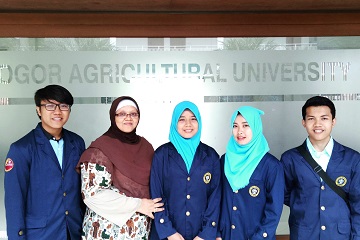
The greatest threat to oil palm (Elaeis guineensis) production in Indonesia is basal stem rot, caused by the white-rot fungus Ganoderma boninense, it is the most destructive disease in oil palm. Alternative control measures to overcome the Ganoderma problem were carried out, one of which by the group of IPB students (Bogor Agricultural University). They are Muhammad Alwin Azhari, Ike Wahyuni Putri, Ahmad Irvan Pratama and Radika Evita Hidayah from the Department of Biochemistry of Faculty of Mathematics and Natural Sciences of Bogor Agricultural University (FMIPA IPB). They have been implementing research project under the sponsorships of the Research Student Creativity Program (PKM-PE) entitled "Fungisida Eco-Friendly Ganoderma boninense Berbasis Nano-trichodermin sebagai Pengendalian Basal Stem Rot pada Kelapa Sawit (Elaeis guineensis) = Eco-Friendly Fungicide Ganoderma boninense Based Nano-trichodermin to Control of Basal Rot Stem on Palm Oil (Elaeis guineensis)".
"Basal Rot Stem on Palm Oil (BPB) disease is caused by Ganoderma boninense pathogen attacking old plants, but also young plants. The earliest external symptoms of basal stem rot of oil palms occur in the foliage, generally after at least half of the cross-sectional area of the stem base has been destroyed. Decay leads to a restriction of water and nutrient supply to the aerial parts, causing symptoms resembling those of water stress and malnutrition. Infection produces a dry rotting of internal tissues at the stem base or root bole and so at any stage in the disease process, the stem or root bole of the infected palm may fracture and the palm will collapse. Until now however, no single control proven to effectively control BSR in the field, "said Alwin.
Chemical control utilizing pesticides can damage the microbial composition in the soil, resulting in the balance of disturbed soil microbial conditions, environmental pollution, and negative impacts on plants and humans.
Currently, there is no perfect methods are available to control this disease completely. The effects of the following fungicides on Ganoderma growth have been tested: drazoxolone and cycloheximide; triadimefon, triadimenol, methfuroxam, carbonix, carbendazim, benomyl, biloxazol, and cycloheximide; hexaconazole, cyproconazole. Hexaconazole can be applied by the soil drenching method and it will be of interest to know the concentration of the residue in the soil after treatment with respect to time. It has an active ingredient that is harmful to the organism in the palm oil environment, so it is unsafe and environmentally unfriendly.
Biological control represents a major alternative to the use of pesticides for the management of plant diseases. Several meaningful antagonists, especially species of Trichoderma, Aspergillus, and Penicillium showed the antagonistic against to Ganoderma boninense related to pathogenic in oil palm and coconut plants. "It needs a better solution in dealing with the problem of stem rot disease that is using a biological agent (certain organism) that is Thricoderma sp.," He said.
Trichoderma is a genus of fungi that is present in all soils, where they are the most prevalent culturable fungi. Many species in this genus can be characterized as opportunistic avirulent plant symbionts. The biocontrol activity involving mycoparasitism, antibiotics and competition for nutrients, also induces defence responses or systemic resistance responses in plants. Trichoderma can control Ganoderma boninense which causes basal stem rot (BSR) disease in oil palm. Trichoderma application that has been given to the planting hole when in pre-nursery, main nursery or planting hole in the field considered less effective and efficient. As biocontrol is an integral part of the IPM philosophy, judicious use of Trichoderma against soilborne pathogens, when demonstrated to be consistently effective, practical and economic, can serve as a model for the introduction and implementation of other biocontrol means into IPM.
"Making in the form of nano-trichodermin will help the use of drugs more efficient (low concentration only), easy to find materials and make it, directly on the target (pest), not toxic and Eco-friendly," he said.
The research was carried out on February – August 2017, at IPB Biochemistry Laboratory and Research Laboratory of Center for Tropical Biopharmaca Study, Bogor, West Java. The method used is the preparation of isolates, nano-emulsion, analysis and encapsulation. Then, dose optimization and antifungal trials of Trichoderma, Nano-Tri chodermin and Hexaconazole against G. boninense were performed. The results showed that the utilization of Nano-Trichodermin were more capable and effective in overcoming stem rot disease (BPB) caused by G. boninense. Detecting and managing the Basal Stem Rot disease caused by Ganoderma need continuous efforts from many parties and with different approaches.
Through this research, Alwin and his group hope to provide a safe and environmentally friendly alternative fungicide that can also inhibit stem rot disease in oil palm plantations, and later this fungi based technology can be useful and developed further for mass production. (Wied)