Recommended the Plant Biodiversity, Students of IPB Created the Application of Poke-Plant Go!
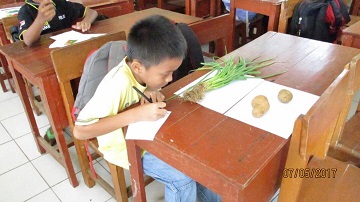
Often we did not recognize the plants that were around us, so that many plants that had not been utilized optimally. The knowledge of the surrounding plants was important, so that the plants could be utilized optimally and grow the concern for the environment. In addition to the benefits of the plants that could be explored, there were also the negative effects of the plants that were less known by the community, especially the elementary school students about the danger of a plant when consumed.
Aditya Ikhsan Maulana, the student of Biology, Bogor Agricultural University (IPB) together with four colleagues namely Saefa Nur A, Arieh Mountara, Raudya Tuzzahra R, and Meilisa Dwi Nurdiyanti created an innovative activity titled Poke-Plant Go!. Namely, the educational program of the introduction of the plant biodiversity as an effort to create the generation of “Melek / Literate” around.
“The lack of the interest of the elementary school students to learn about the biodiversity is still a problem in itself. With the outbreak of the game of “Pokemon GO!” that exists today, it is expected that the program of Poke-Plant Go! can help attract the elementary school students to study the plant biodiversity, so as to be able to form the generation which is “melek / literate” around,” said Adit.
Adit with the team selected SDN Sirnagalih 02, Sukamantri Village, Bogor District as a place of the idea implementation. SDN Sirnagalih 02 had 440 students divided into 12 classes, namely the 1st class to the 6th class.
This program was aimed at the students of the 5th class of 79 children. The 5th class students were divided into two classes namely class A and class B. Based on the statement of the principal, the students of SDN Sirnagalih 02 had never received the education on the plant biodiversity previously, so that this was the first program that taught about the plant biodiversity. This program was aimed to introduce the diversity of the plants that were around SDN Sirnagalih 02, so that the plants around could be used optimally.
“Around the elementary school, it is found a high diversity of plants. There are approximately 100 species of plants that exist in the neighborhood around the school, including in it the medicinal plants and the toxic plants that are less well-known to the community. Other than that, there are also the plants that are used as the ornamental plants,” he said.
The activities that were carried by Adit with his team lasted for 5 months. The first month was conducted the preparation and the observation as well as the plant mapping. In the first week of the 2nd month, it was conducted the program opening together with the principal, the teachers and the students who would be involved in the program. The next activity was “Poke Hunt”, namely the activities which were looking for and identifying the surrounding plants using the distribution map and the Pokelog book, as well as reporting the plants found to the companion. The activities of Poke Hunt were conducted in the 2nd week of 2nd month until the 4th week of the 4th month. The students were divided into some groups and accompanied by 1 member of PKM-M and 1 teacher.
Pokelog Upgrade was a method of upgrading in finding and knowing the plants. The students who were managed to find all plants existed in Pokelog in the span of 2 meetings would be given the Pokelog Upgrade.
The Pokelog Upgrade contained some plants that were harder to find, so that it had a higher difficulty level, hopefully the students were more passionate and active in recognizing the plants around the school. The Pokelog Upgrade was conducted 2 times, namely on the 2nd week of the 3fd month and the 4th week of the 4th month. The students who had not managed to find all plants in Pokelog, continued the activities of the Poke Hunt as usual.
The next was “Gym Fight”, namely the method to test the students’ knowledge about the plants which they had encountered during the Poke Hunt. The gym fight was played by two parties i.e. the students and the members of PKM-M or the companion teacher.
This game used one set of cards for the students and one set of cards for the members of PKM-M and the companion teacher. The contents of each card was a photograph of the plants along with a brief description of 1 plant. The cards could ‘fight’ against each other based on the predetermined level, the intention of the fighting here was the player issuing the appropriate type of the card to fight his opponent. How to play the gym fight was one on one, namely the member of PKM-M or the teacher would show one card and the student should show another card that could beat the card.
The last was the Poke Ask Question (PAQ), namely a means to answer the student question. The member of PKM-M gave the exposure to question asked by the students during the event. In the activities of PAQ, the students were allowed to provide the questions that were not yet on the list of the questions of PAQ. This activities were done 2 times, on the 2nd week of the 3rd month and 4th week of the 4th month. The activities of PAQ became a means of monitoring and evaluation of the students in the last week.
“The program of the Poke-Plant Go! is the solution to address the low awareness and the interest of the students to study the diversity of the surrounding plants. The continuation of this program is with the cadre of the teachers or the students who will continue this program. It is expected the program of the Poke-Plant GO! can continue in SDN Sirnagalih 02 and can be applied in other elementary schools in Indonesia,” he said.(IR/Zul)