
IPB Sent Locusta Expedition to Handle the Locust Pest Blast in NTT
The locust pest (Locusta Migratoria) had attracted the attention of the Indonesian public and even the world. In June 2017, this pest was horribly attacking all types of plants starting from the maize, the cassava, the coconut, the forest plants, on the area thousands of hectares in Sumba, East Nusa Tenggara (NTT). A terrible sighting, until it was like a cloud which was ready to devastate, occured when the locust flew in the affected area of the garden. Even so extraordinary, the locus pest blast in Sumba this year caused the disruption to the flight. Waingapu Airport was closed for several days.
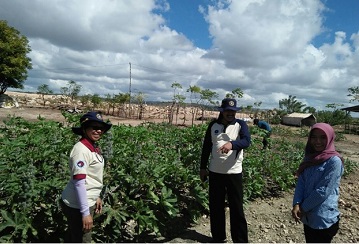
Therefore, Bogor Agricultural University (IPB) sent the Team of Experts chaired by the Chairman of Institute for Research and Community Services (LPPM), Dr. Prastowo in Ekspedisi Locusta IPB. The experts consisting of Dr. Hermanu Triwidodo (an ecologist of insect), Dr. Yayi M. Kusumah (an insect pathogen expert), Dr. Widodo (Head of Plant Clinic) were in Sumba since 9-13 July 2017.
In Sumba, the team conducted the field research and training for farmers and officers about the control of locust that did not damage the environment. The research and training were conducted with the support of the lecturer of Universitas Kristen Wirawacana of Sumba and the Agricultural Office of East Sumba.
On the occasion, the Head of LPPM of IPB, Dr. Prastowo, handed over the insect biological controlling agents such as Lecanicillium, Beauveria, and Metarhizium to the Regional Secretary of East Sumba, to be reproduced. This technology was as one of the important components of the environmentally-friendly locust control.
“In the beginning 2017, the warning about this locust pest blast is already submitted by Dr. Hermanu Triwidodo. We coordinate with Sumba District Government to strategize ahead, so that this pest blast will not happen again,” he said.
The team of IPB did a quick assessment of the damage caused by the locust pest blast among them, to identify the cause of the outbreak and exploration of the microorganism that could be the locust disease.
As known abroad, this locust was effectively controlled by an insect pathogenic fungus i.e. Metarhizium anisopliae var. acridum. But the Metarhizium strain of the locust had not been collected in Indonesia. Various agricultural and plantation institutions in Indonesia had a collection of Metarhizium isolate from the coconut beetle or wereng, but it could not be used for the locust control.
“This locust is like human too, which can get sick. The team of IPB is developing an effective microorganism (disease) in controlling the locust. This microorganism is much safer to the environment and also harmless to the human and the livestock,” explained Dr. Yayi M. Kusumah.
Meanwhile, according to Dr. Hermanu, the locust control by using insecticide was a suicide step. The use of insecticide on a massive scale would turn off the complex of the natural enemy and the useful insect, while the locusts themselves did not die. Furthermore, this would cause a terrible domino effect, namely another pest blast, as well as the water and soil contamination. The presumption that the insecticide was the ultimate weapon should be straightened out.
“ Finally what, it is not effective,” said Dr. Hermanu.
With the field research continued with the existing institutional excavation, as well as the development in the laboratory of the Department of Plant Protection of IPB, hopefully in a short time could be devised the right strategy to handle the locust in NTT in the future.(**/Zul)

