Innovation of Bajak Tiga Cakar by Student of IPB Helped the Sugarcane Farmer
Had you ever noticed the agricultural land in Indonesia? In general, the farmer in Indonesia had the land with an average small land area of around 0.3 Ha. The agricultural expert also developed the agricultural machinery which was suitable with the small land condition as well as many scattered in the mountainous areas that were difficult to access by the large machines produced by the manufacturers from abroad. Various field conditions were also studied to develop the agricultural tools to improve the quality and the quantity of the local agricultural products.
The process of the agricultural cultivation was started from the processing of the land using the heavy equipment such as the tractors. The loose soil became an important factor for plant roots to grow well. Likewise, which was needed in the sugarcane plantation, the soil processing became a routine activity which was carried out before the planting period was began. Various obstacles were experienced in this sugarcane farm, such as the problem of the residual harvest of the sugarcane and the plastic that was not transported from the land. The remainders of the harvest and the plastic that were not transported from the land had made the plow work to be difficult.
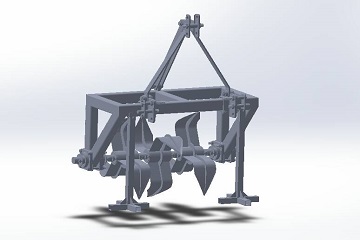
The innovation was conducted by the student of IPB through PKM Karsa Cipta to design the tool of Bajak Tiga Cakar (BTC) / Plow Three Claws to resolve the issue. Bajak Tiga Cakar / Plow Three Claws was a soil cultivator that worked like a sugarcane field machine which had the problem of the rest of the harvest and the waste. The key of the BTC tools was in the plow’s eye especially designed by the team headed by Ihsanul Fajri and the members of Fachmi Andriyanto, Sulthon Arif Rakhman, and Tito Dwi Saputra from the Department of Mechanical Engineering and Biosystem, the Faculty of Agricultural Technology.
“The applied principle of the eye of BTC follows the work of the hoe. The soil condition after being plowed with BTC will be more loose, and the remaining harvests and the plastics become smaller sizes. The efficiency of the plow on the plowing thereafter will increase, because the plowing no longer hinders the hard elements The easier plowing of course makes the uses of the fuel plows become more efficient,” said Ihsanul Fajri.
The fabrication process was done in Bogor in the form of the prototype of the plow which required 55 HP power, it was smaller than a plow in general which required 110 HP. Three disks of BTC which were strung together could still be modified to be more than that amount. The testing tool would be done in the Experimental Plantation of Leuwikopo, Bogor.
“We hope the technology of BTC can be implemented in the sugarcane plantation in Indonesia to improve the management of the sugarcane production. The main target is the fabrication en masse and the distribution to smallholder sugarcane plantations. The modification of the tool is also very possible, such as the increased of the power and the addition of the disk for the large scale plantation. Hopefully, the innovation continues to flow, and Indonesian agriculture is progressing in the future,” he explained. (EAW/Zul)